16 Best Hikes in Zermatt - Your Complete Guide for Hiking in Zermatt from Easy to Difficult
1. Blatten - Zermatt’s most charming historic hamlet
Difficulty: Very easy ★☆☆☆☆
Time: 30–45 minutes (return: 1–1.5 hours)
Season: All year (best from May to October, charming in winter too)
Many visitors head straight for the famous mountain railways and never discover Blatten, a tiny hamlet only a short walk from the centre of Zermatt. If you are looking for an easy introduction to the village and its history, this is one of the best walks you can do.
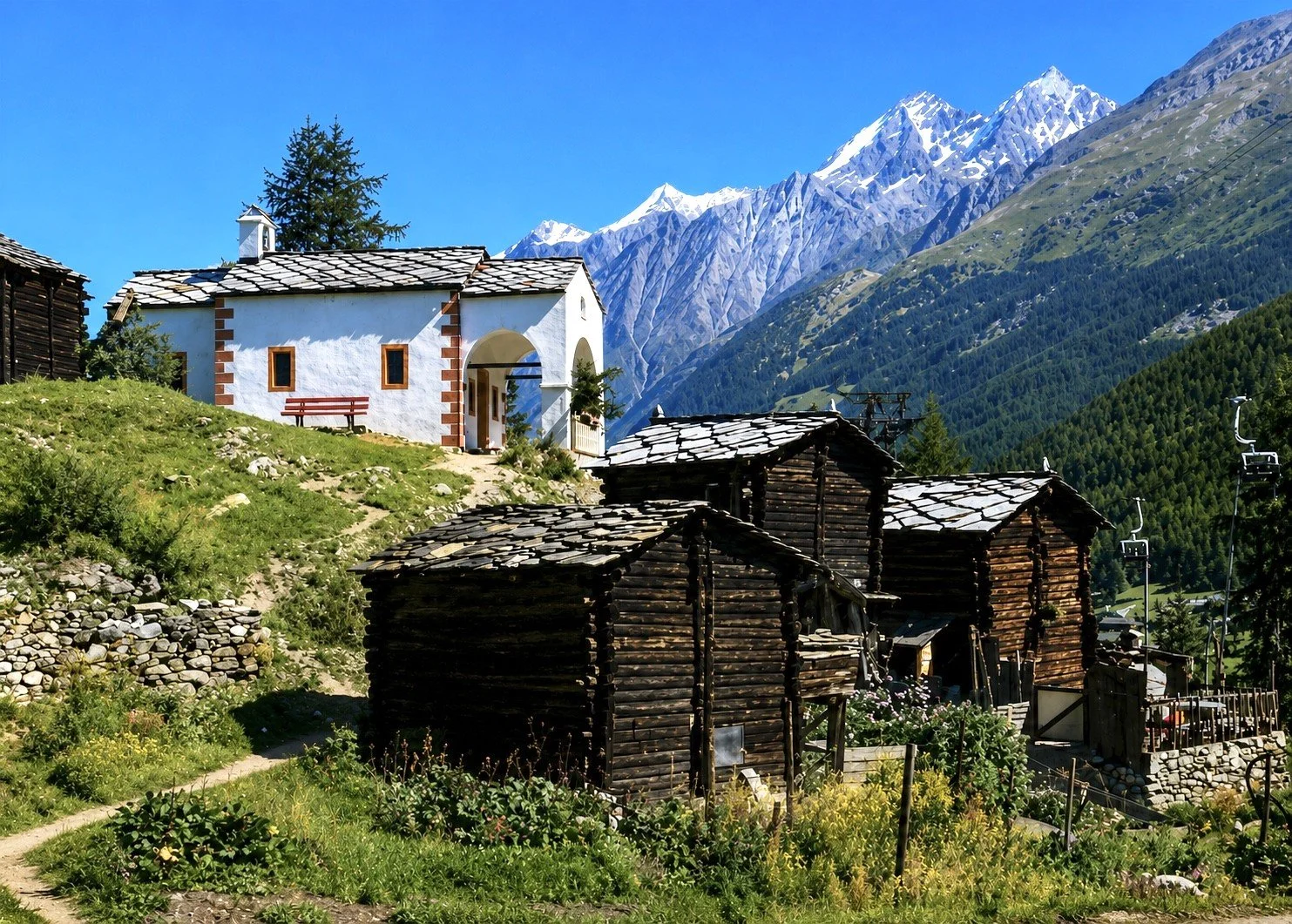
Blatten lies at around 1,740 metres above sea level and was once a traditional summer farming settlement (known as a Maiensäss). Today, its centuries-old dark larch houses, small Baroque chapel, flower-filled meadows and mountain restaurants make it one of the prettiest corners of Zermatt.
The walk begins in the village centre and climbs gently through quiet residential streets before reaching the historic hamlet. Along the way you’ll enjoy beautiful views over Zermatt, and once you arrive, it’s worth taking time to wander between the old wooden barns and visit the Maria Rosenkranzkönigin Chapel, one of the most picturesque chapels in the valley.
If you have more time, Blatten is also the perfect starting point for continuing towards Zum See, Furi, or even Zmutt, making it an excellent first stop on a longer day out.
Blatten vs Zmutt – what’s the difference?
This is something many visitors don’t realise.
Blatten is the closest historic hamlet to Zermatt. It can be reached in around 30 minutes on an easy walk, has several restaurants, a beautiful chapel and is ideal for families or anyone wanting a gentle stroll.
Zmutt, on the other hand, feels much more remote. The hamlet is over 500 years old, sits higher above the valley and requires around 1½ hours of walking from Zermatt. It has a wonderfully preserved collection of traditional Walser houses and offers a much quieter, more authentic mountain atmosphere.
Insider tip: If you enjoy Blatten, continue your exploration with the walk to Zmutt. While Blatten is the easiest historic hamlet to reach, Zmutt offers an even more authentic glimpse into old Valais life and is one of the most beautiful walks in Zermatt.
2. Zmutt – Discover One of Switzerland’s Oldest Alpine Hamlet
Difficulty: ★★☆☆☆ Easy
Time: Around 45 minutes one way
Season: Summer (best from late May to September)
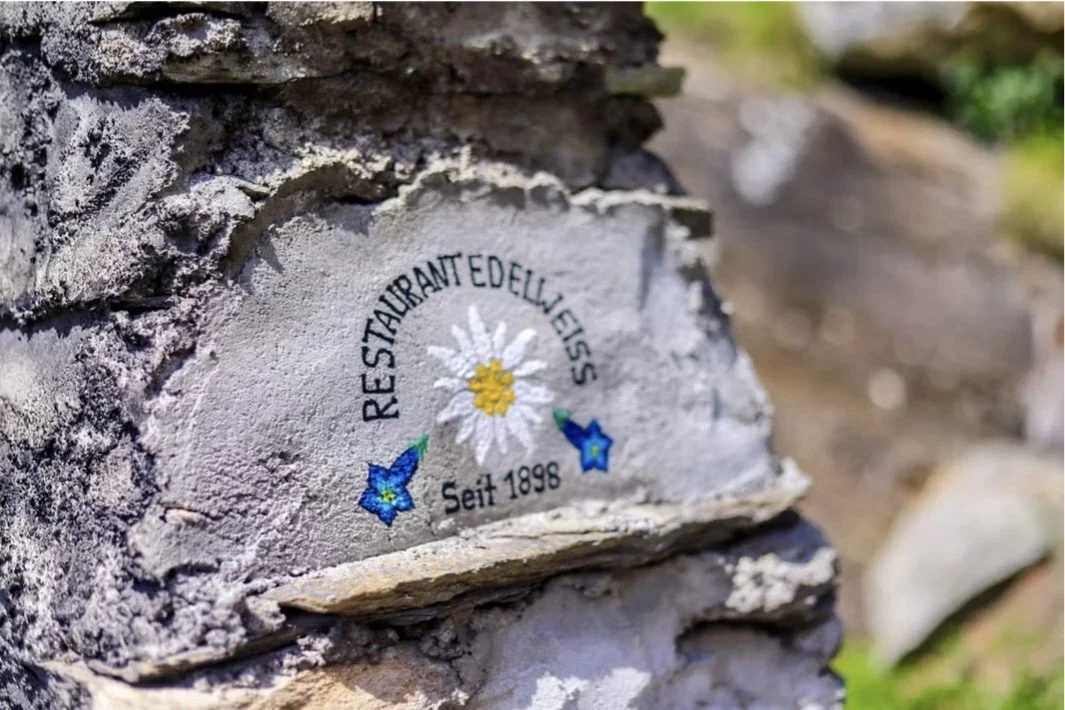
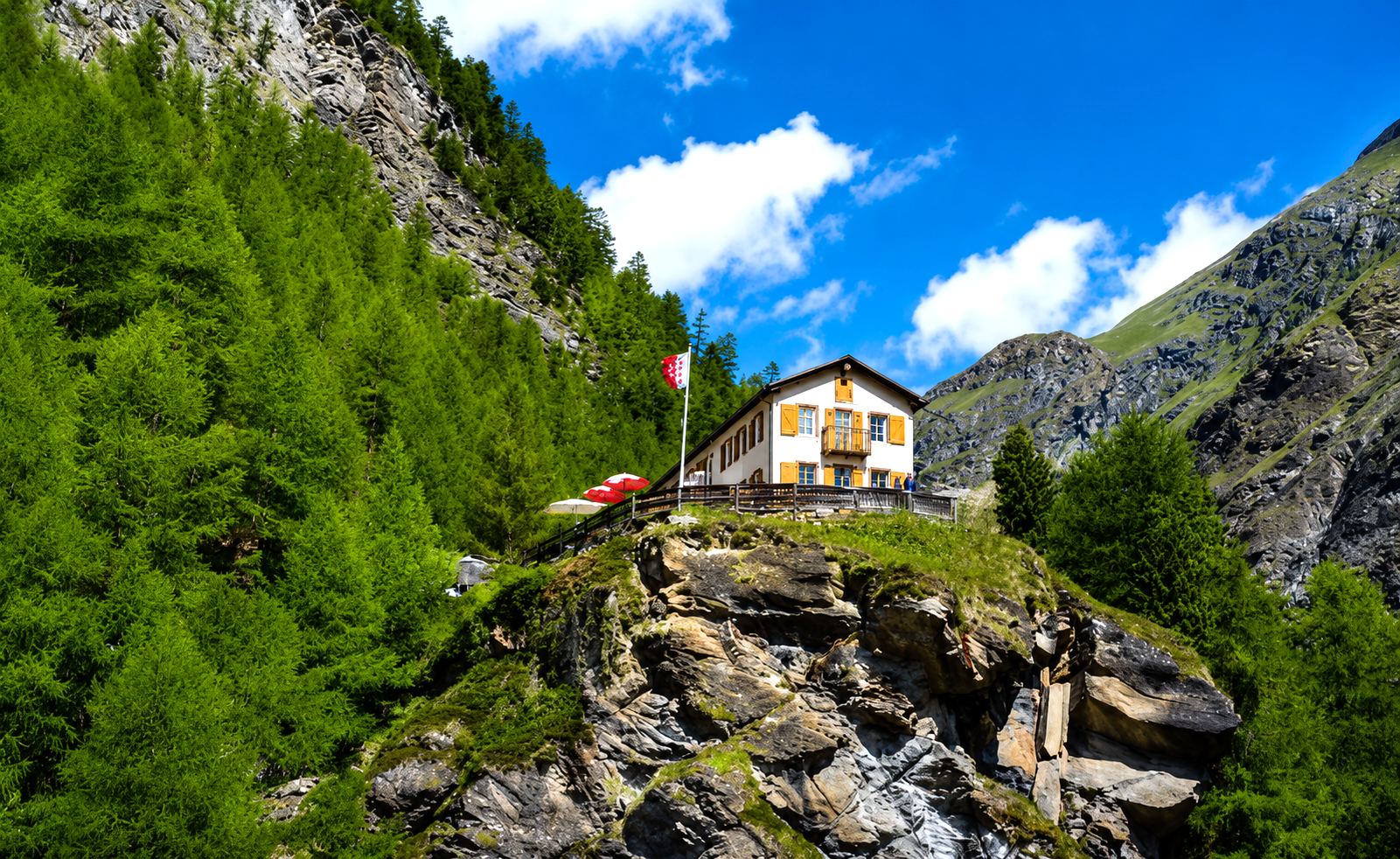
If you’re looking for a rewarding short hike without travelling far from Zermatt, the walk to the Edelweiss Hut is an excellent choice. Perched on a rocky ledge above the village, the mountain restaurant offers beautiful views over Zermatt towards the Rothorn, Gornergrat and the Mischabel range. The climb is fairly steep, but it is short, well marked and manageable for most walkers at a relaxed pace.
The trail begins at the upper end of Zermatt and climbs steadily through the forest. Part of the route now includes a series of stairs where the previous path was damaged, adding a slightly unusual section to an otherwise straightforward ascent.
The Edelweiss Hut is a wonderful place for a small morning or afternoon outing. You can walk up early for coffee, stop for lunch or arrive later in the day to sit on the sunny terrace and enjoy the view over the village. The restaurant serves homemade quiches and traditional dishes, and it is open daily during its summer season.
Insider tip: During the summer months, stronger walkers can continue for roughly another hour towards Trift. The route becomes steeper and more demanding, but leads into the beautiful and peaceful Trift Valley. You can stop for a meal or refreshments at the Trift mountain inn during its summer opening period before returning to Zermatt.
3. Edelweiss Hut – A Scenic Climb Above Zermatt
Difficulty: ★★☆☆☆ Easy
Time: Around 1–1.5 hours one way from Zermatt (depending on the route)
Season: All year (best from May to October). In winter, only the lower path from Zermatt and the maintained road from Furi are normally accessible. The Kulturweg and the middle trail are snow-covered and may be closed because of avalanche danger.
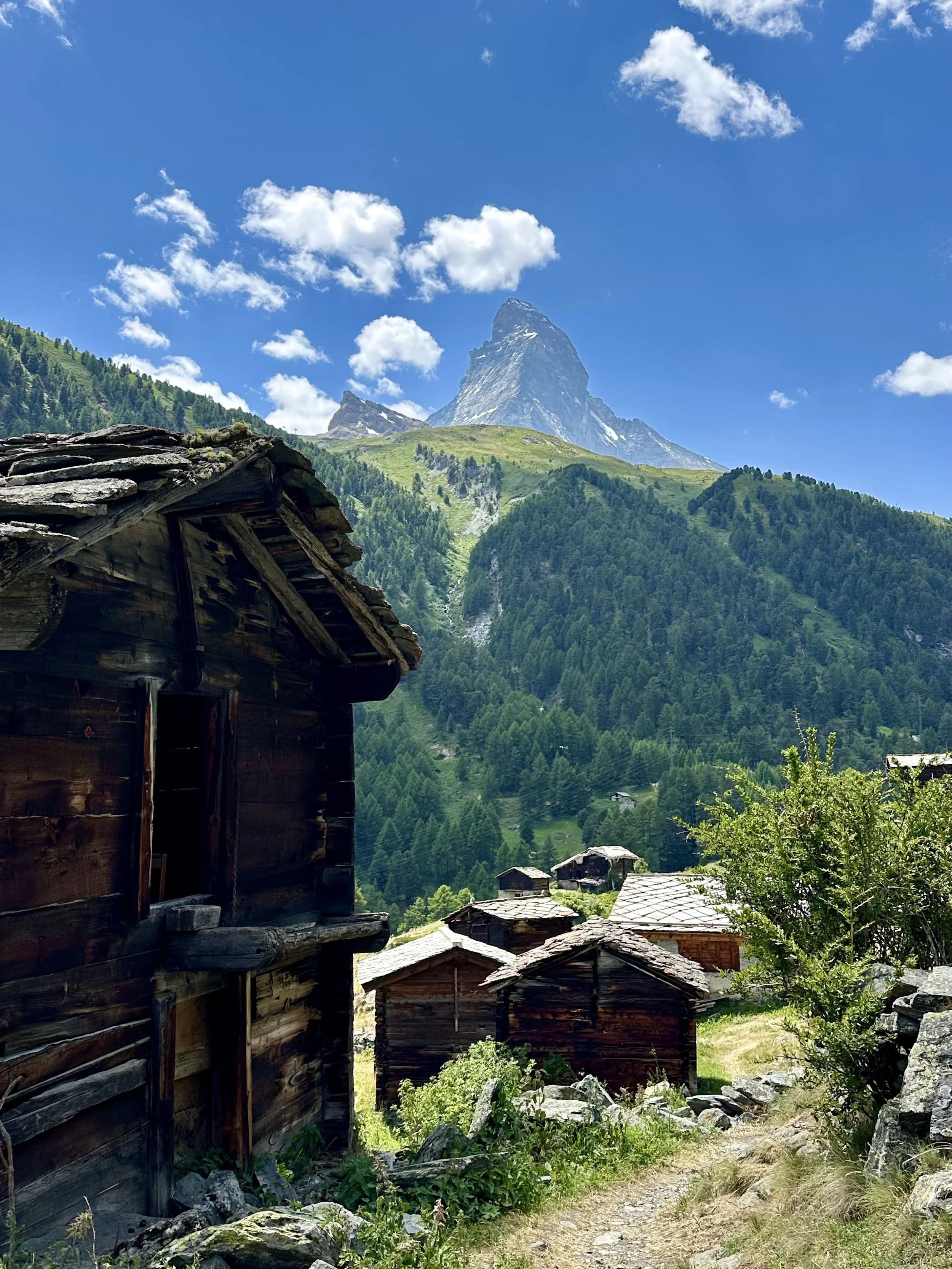
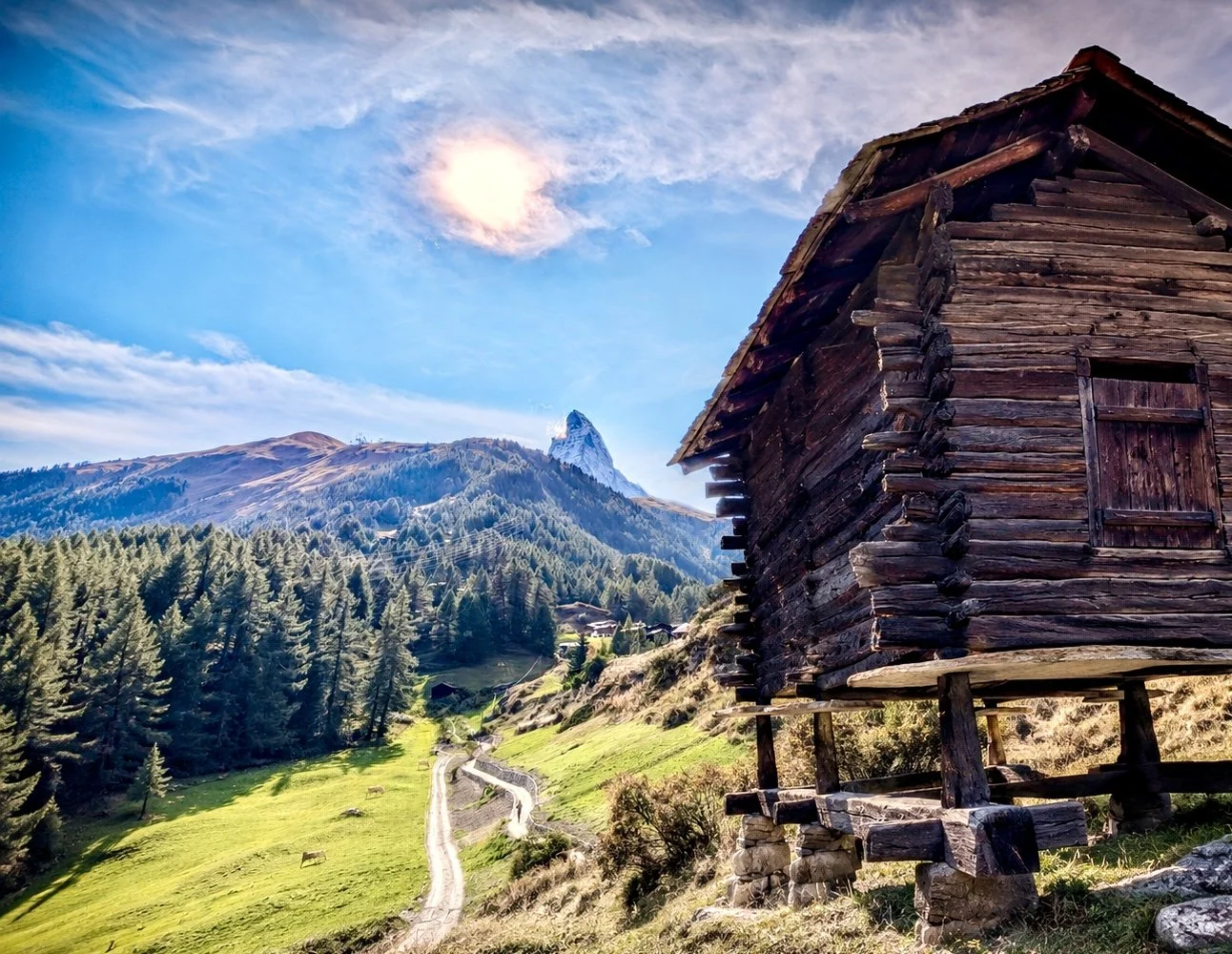
If you’re looking to experience the quieter, more traditional side of Zermatt, a walk to Zmutt is one of the most rewarding outings in the valley. Surrounded by alpine meadows beneath the Matterhorn, this beautifully preserved hamlet feels like stepping back in time. With its centuries-old dark larch houses, peaceful atmosphere and spectacular mountain scenery, it’s easy to see why many locals consider it one of the most beautiful places around Zermatt.
One of the things that makes Zmutt special is that there isn’t just one way to reach it. Depending on how much time you have and what kind of walk you’re looking for, you can choose from four different routes.
The Kulturweg is the most scenic option. This themed trail passes through alpine meadows while a series of information panels introduces the history, culture and natural environment of the valley. Along the way you’ll enjoy beautiful views of the Matterhorn, which appears and disappears between the trees, making every section of the walk feel different.
The middle forest trail offers a quieter alternative through peaceful woodland and is perfect if you prefer to avoid the busier trail.
The lower route follows the valley and is the easiest and flattest way to reach Zmutt directly from Zermatt, making it an excellent choice for families or anyone looking for a gentle walk. It is also the preferred walking route during winter.
Finally, you can also reach Zmutt from Furi by following the well-maintained road. Together with the lower path from Zermatt, this is one of the two suitable winter approaches. The Kulturweg and the middle forest trail should not be used in winter, as they are snow-covered and may be exposed to avalanche danger.
After around an hour’s walk, you’ll arrive in Zmutt at 1,936 metres above sea level. Home to a handful traditional wooden buildings, many dating from the 13th to the 16th centuries, the hamlet is considered one of the oldest continuously preserved settlements in the Alps. Dendrochronological research has even identified it as the oldest precisely dated hamlet in Switzerland and among the oldest in the entire Alpine region.
Take your time wandering through its narrow lanes, where remarkably little has changed over the centuries. During the summer months, you can also enjoy lunch or a traditional Swiss meal at the small mountain restaurant before choosing one of several scenic routes back to Zermatt.
Insider tip: Most visitors walk straight into Zmutt and miss one of the area’s hidden gems. Just before the final descent into the hamlet on the Kulturweg, take the small path branching to the right. A few minutes later you’ll reach a peaceful alpine plateau with magnificent Matterhorn views. It’s one of our favourite quiet spots in Zermatt—often with nothing but the mountains, wildflowers and complete silence around you.
4. Sunnegga – A Beautiful Walk to Zermatt’s Sunny Terrace
Difficulty: ★★☆☆☆ Easy
Time: Around 1.5 hours one way
Season: All year (best from May to October & from December to March)
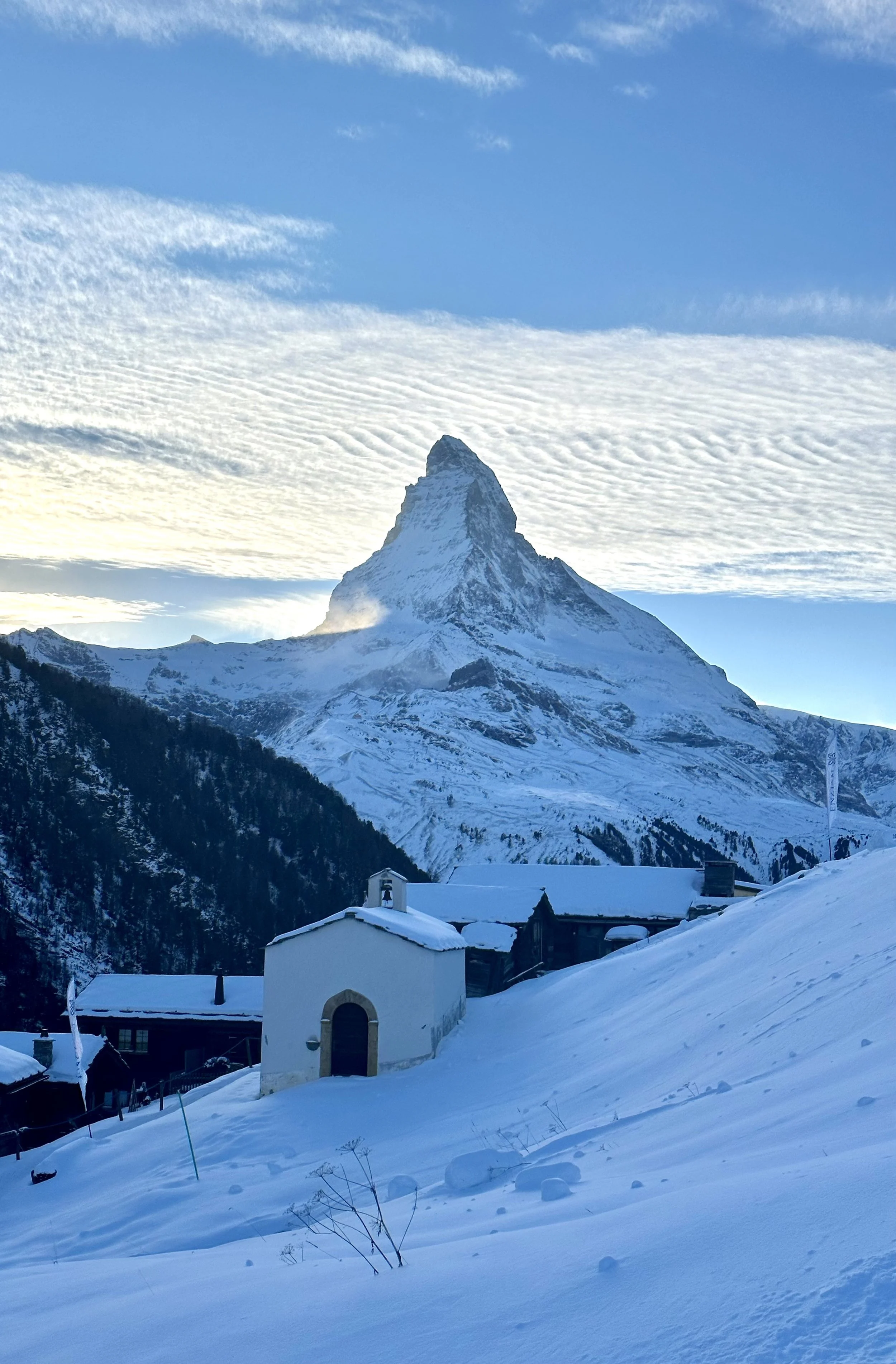
If you’d like to reach Sunnegga without taking the funicular, this is one of the most enjoyable easy walks starting directly from Zermatt. Rather than following the steeper forest trails, begin just behind Hotel CERVO and follow the well-signposted hiking path towards Sunnegga. The trail climbs gently above the village, giving you increasingly beautiful views over Zermatt and the Matterhorn before gradually gaining height through peaceful forest. It makes for a relaxed half-day outing and is suitable for most walkers.
About halfway along the walk, you’ll reach the historic hamlet of Findeln. Surrounded by traditional wooden chalets and flower-filled meadows, Findeln is one of the most picturesque places above Zermatt and offers magnificent views of the Matterhorn. It’s the perfect place to slow down, enjoy the scenery and experience a quieter side of the valley.
Just above the hamlet you’ll find the famous Chez Vrony, one of Zermatt’s best-known mountain restaurants. This Michelin-recommended restaurant has welcomed visitors for more than a century and is renowned for its exceptional regional cuisine and spectacular Matterhorn terrace. If you’d like to eat here, we strongly recommend making a reservation well in advance, especially during the summer months.
From Findeln, the trail continues gently uphill to Sunnegga, often called Zermatt’s sunny terrace. At the top you’ll find a mountain restaurant with panoramic views of the Matterhorn and the surrounding peaks. In summer, it’s an excellent place to relax before walking back to Zermatt, while in winter it becomes a popular meeting point for skiers exploring the Sunnegga ski area.
Insider tip: Instead of taking the funicular back to Zermatt, walk back down through Findeln and enjoy the peaceful descent to the village. Finish your day at Hotel CERVO, where you can relax with a drink on the beautiful terrace while enjoying one last unforgettable view of the Matterhorn. It’s the perfect way to end one of Zermatt’s most scenic easy walks.
5. Five Lakes Trail – Zermatt’s Most Famous Hike
Difficulty: ★★☆☆☆ Easy
Time: Around 4 hours
Season: Summer (best from July to October)
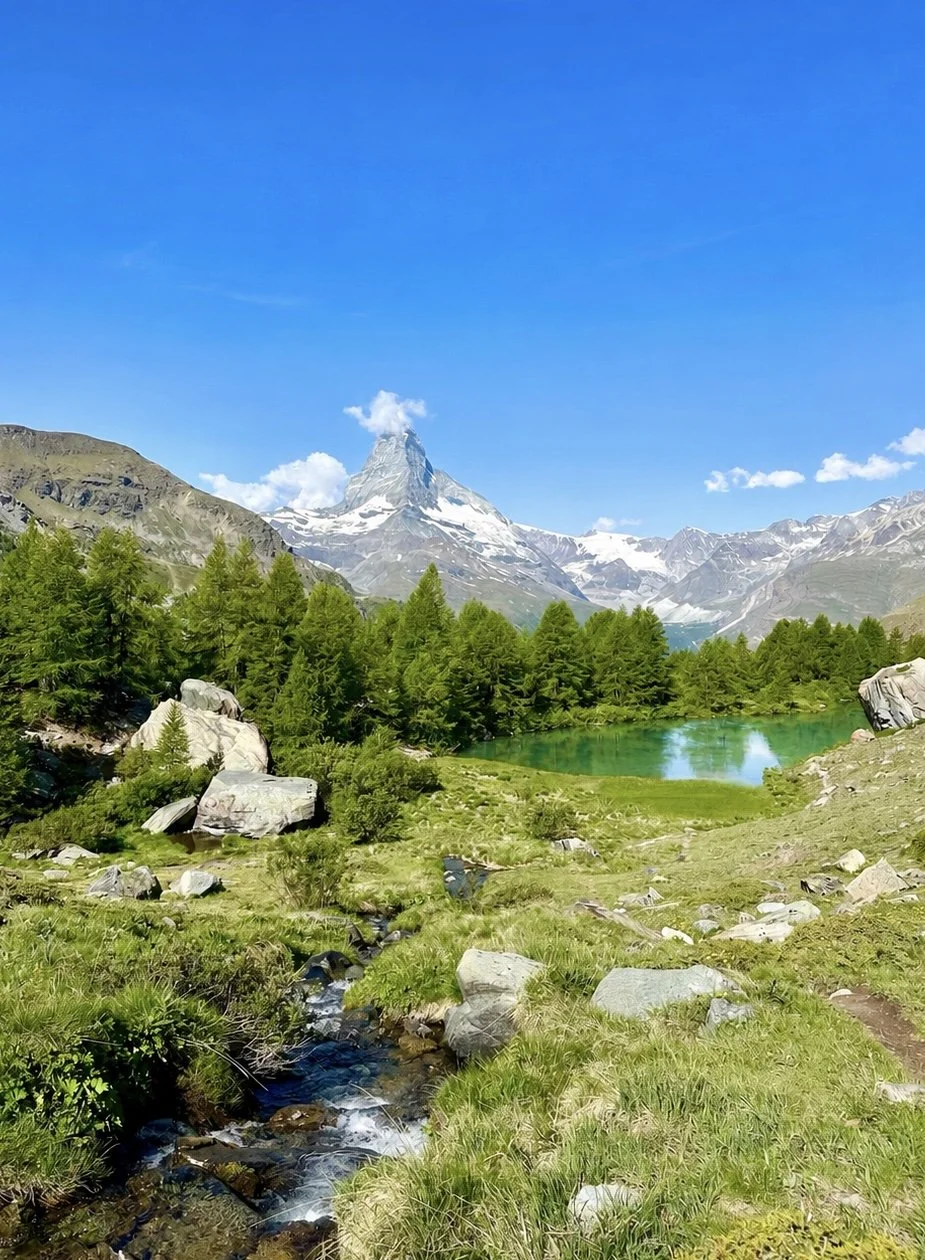
If you’re looking for one hike that perfectly captures the beauty of Zermatt, this is it. The Five Lakes Trail is one of the region’s most famous walks, combining spectacular Matterhorn views with five completely different alpine lakes. The hike begins at Blauherd, reached by taking the Sunnegga funicular followed by the gondola to Blauherd, before gently descending back towards Sunnegga.
The first stop is Stellisee, perhaps the most iconic lake in Zermatt. On a calm day, the Matterhorn is perfectly reflected in its crystal-clear water, creating one of the most photographed views in Switzerland. The lake has a peaceful atmosphere and is the perfect place to pause before continuing your walk.
A little further along lies Grindjisee, our favourite of the five. Surrounded by alpine meadows and rare mountain flowers, it feels far wilder than Stellisee. The water is exceptionally clear, and if you walk a little upstream above the lake, you’ll discover one of the most beautiful viewpoints of the Matterhorn reflected above the valley.
Next comes Grünsee, where the scenery changes completely. This beautiful mountain lake is one of the two lakes where swimming is allowed, and on warm summer days its clear turquoise water is incredibly inviting. Beyond it lies Moosjisee, instantly recognisable by its striking milky turquoise colour created by glacial meltwater. Finally, the trail reaches Leisee above Sunnegga, a favourite swimming spot for local families where generations of Zermatt children have learned to love the mountains.
From Sunnegga, you can either take the funicular back to Zermatt or enjoy the pleasant walk back down to the village on well-marked hiking trails.
Insider tip: If you’re looking for a full-day adventure, skip the lifts altogether. Start in Zermatt, hike via Sunnegga and continue all the way to Blauherd before completing the Five Lakes Trail on foot. This turns the outing into a rewarding full-day hike of around 6–8 hours with approximately 900 metres of ascent. It requires a moderate level of fitness, but you’ll experience far more of the mountains than visitors who simply ride the lifts.
6. Gornergrat – One of the World’s Greatest Mountain Viewpoints
Difficulty: ★★★☆☆ Moderate
Time: 4–8 hours (depending on the route)
Season: Summer (best from July to October)
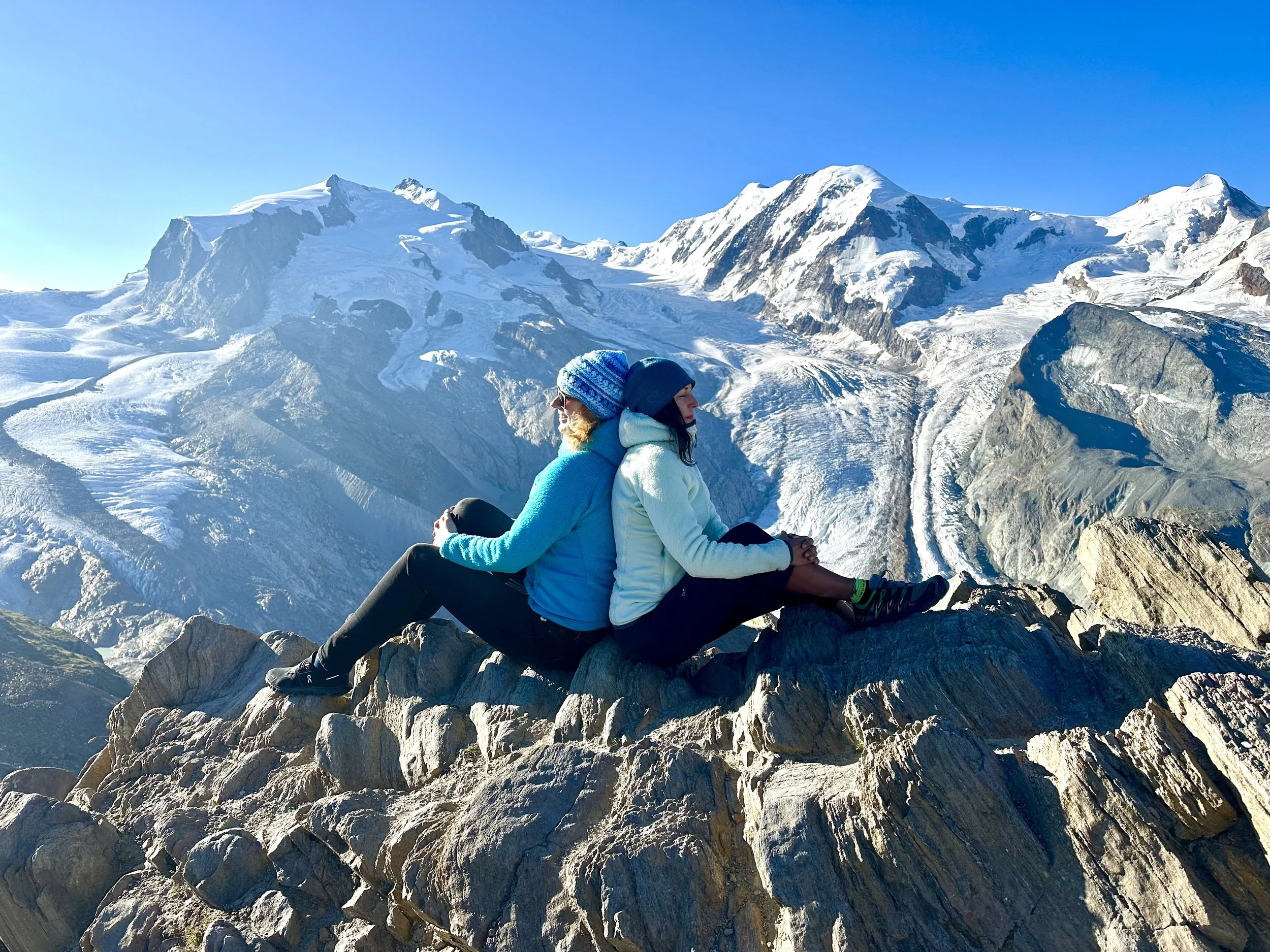
No visit to Zermatt is complete without experiencing Gornergrat. At 3,089 metres above sea level, it offers one of the finest mountain panoramas anywhere in the Alps, with breathtaking views of the Matterhorn, Monte Rosa, the Gorner Glacier and no fewer than twenty-nine peaks over 4,000 metres.
There are two excellent ways to enjoy this hike. The most popular option is to take the historic Gornergrat Railway to either Riffelalp, Riffelberg or all the way to Gornergrat, then explore the area on foot before walking back down to one of the stations. This allows you to experience the spectacular scenery without committing to a long ascent.
If you prefer a bigger challenge and would rather avoid the cost of the railway, you can also hike all the way from Zermatt. The trail climbs steadily through forests and alpine meadows before reaching the high alpine landscape above Riffelalp and Rotenboden. Although considerably longer, many hikers find this far more rewarding than simply taking the train.
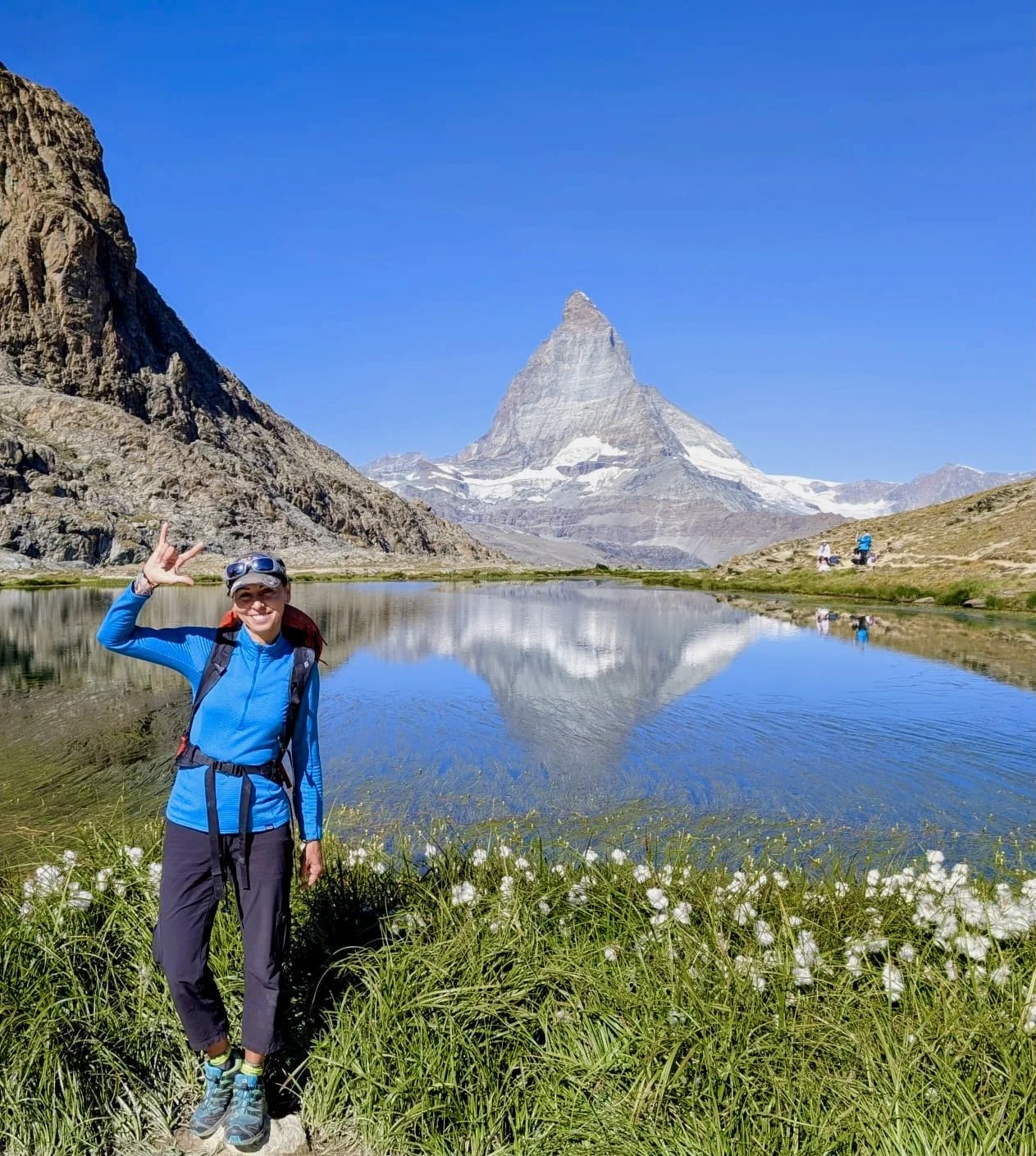
Before reaching the summit, make time to stop at Riffelsee, the famous mountain lake just a few minutes from Rotenboden station. On calm mornings and evenings, its still water creates one of the world’s most iconic reflections of the Matterhorn. Just beyond lies a second, smaller lake that is often much quieter and equally photogenic.
From Gornergrat itself, you’ll enjoy panoramic views in every direction. The viewing platform overlooks the Gorner Glacier, Switzerland’s second-largest glacier, while the Monte Rosa massif, Lyskamm, Breithorn, Castor, Pollux and many other famous summits dominate the skyline. Whether you arrive on foot or by train, it’s one of those places where it’s worth simply sitting down and taking in the scenery.
Insider tip: Most visitors stop at the Gornergrat viewing platform before catching the next train back to Zermatt. Instead, continue a little further along the ridge beyond Gornergrat. Within a few minutes the crowds disappear, leaving you with magnificent views towards Monte Rosa, the Mischabel range, Rimpfischhorn and the surrounding glaciers. It’s one of the quietest places in the entire Gornergrat area and the perfect spot to sit, relax and enjoy one of the finest mountain panoramas in the Alps.
7. Matterhorn Glacier Trail – A Journey Through Rock, Ice and Glacial History
Difficulty: ★★★☆☆ Moderate
Time: 4–8 hours
Season: Summer (best from July to October)
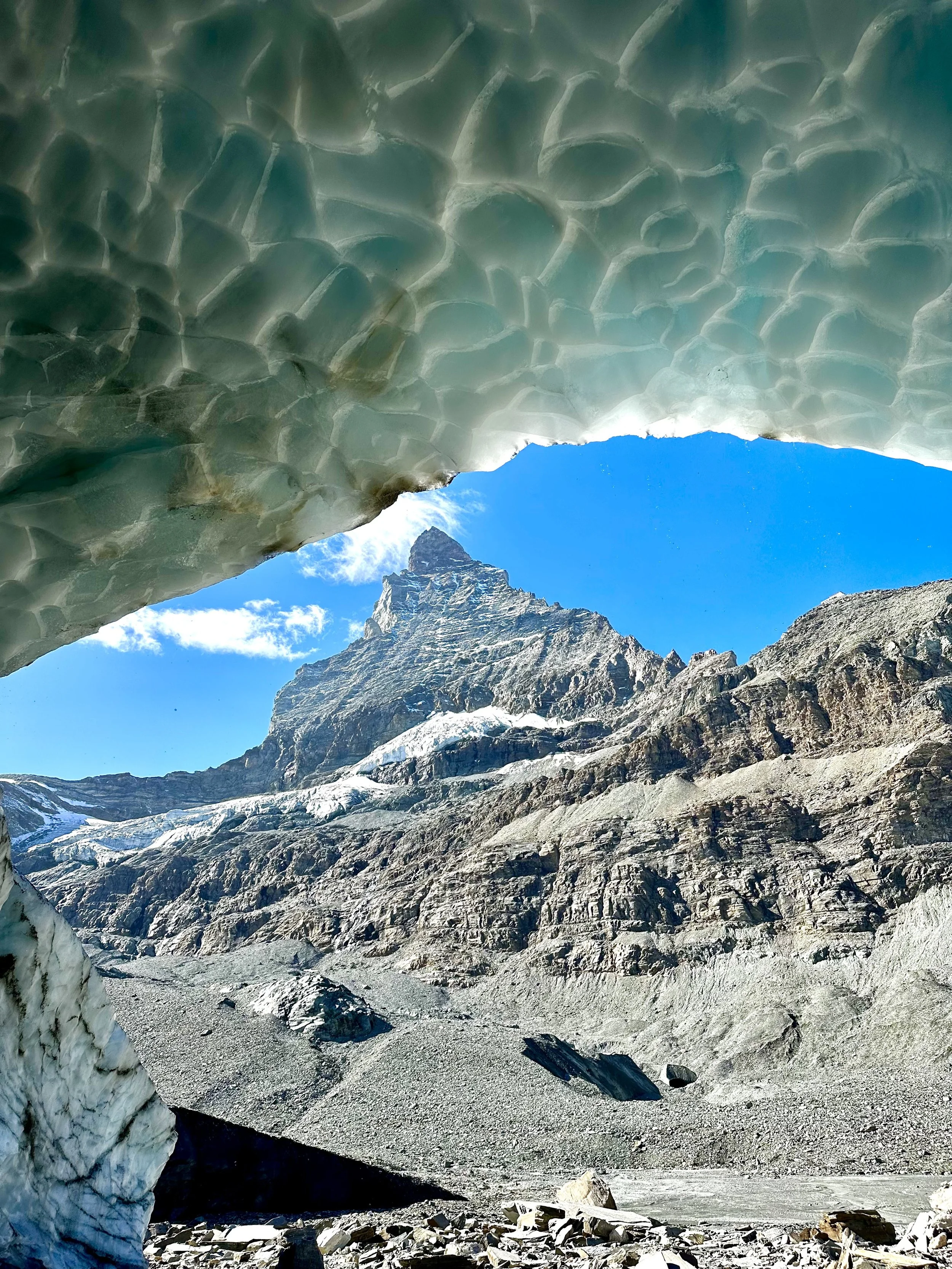
If you’ve ever wondered what a landscape looks like after a glacier retreats, the Matterhorn Glacier Trail is one of the most fascinating hikes in Zermatt. Unlike the flower-filled meadows lower down the valley, this is a harsh, high-alpine world shaped almost entirely by ice. Bare rock, glacial moraines, crystal-clear meltwater pools and the immense east face of the Matterhorn create a landscape that feels almost untouched by time. The trail also follows the retreat of the Furgg Glacier, with information panels explaining how the mountain has changed over the past century.
There are two excellent ways to experience the hike.
The easier option is to take the cable car to Trockener Steg and walk the Matterhorn Glacier Trail downhill towards Schwarzsee. This is the classic route and allows you to enjoy the scenery without a long ascent. The trail is well marked throughout, but remember that you are still in high alpine terrain. Stay on the marked path at all times, watch your footing on loose rocks and never underestimate the mountain conditions.
If you’d rather avoid the cable car and are looking for a full-day adventure, start in Zermatt and hike via Furi and Furgg before reaching Trockener Steg. From there, complete the Matterhorn Glacier Trail to Schwarzsee before walking back down to Zermatt. This creates one of the finest full-day hikes in the valley while saving the cost of the lift.
Along the route you’ll pass several small glacial lakes and pools formed by the retreating ice. Their striking turquoise and milky-blue colours come from fine rock particles suspended in the meltwater. The trail constantly changes character as it winds through glacial moraine, polished rock slabs and barren alpine terrain where only the hardiest plants can survive. Towering above you for almost the entire hike is the spectacular east face of the Matterhorn, making this one of the closest and most dramatic encounters with the mountain that is possible without climbing it.
The trail finishes at Schwarzsee, where you can either take the cable car back to Zermatt or continue walking down to the village if you still have energy.
Insider tip: Find one of the small glacial lakes away from the main path, sit quietly for a few minutes and simply take in the landscape. With the Matterhorn rising above the ancient glacier, the silence, colours and raw beauty of this high-alpine environment create one of the most memorable moments anywhere in Zermatt.
Difficulty: ★★★☆☆ Moderate
Time: Around 4–6 hours
Season: Summer (best from July to October)
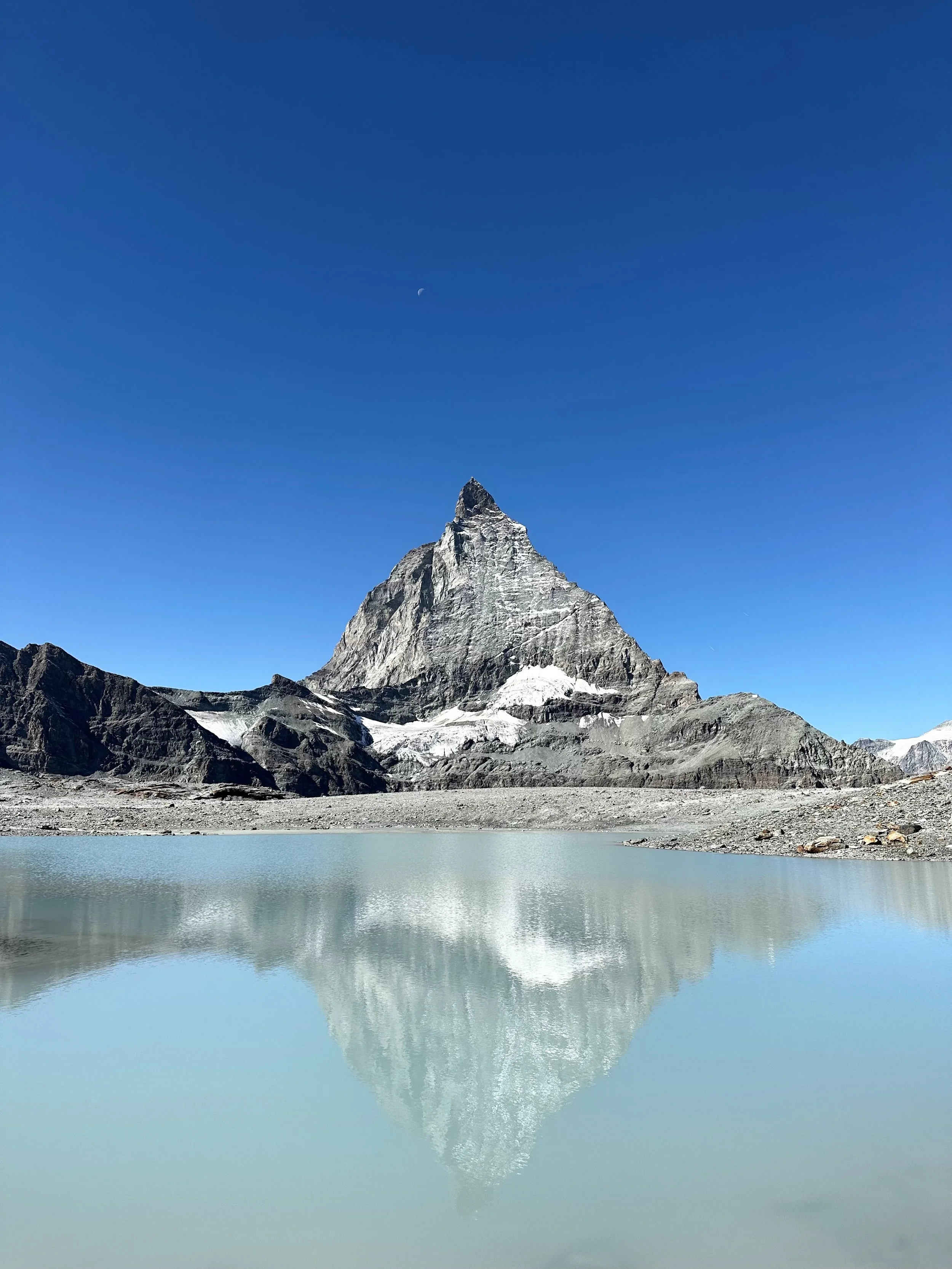
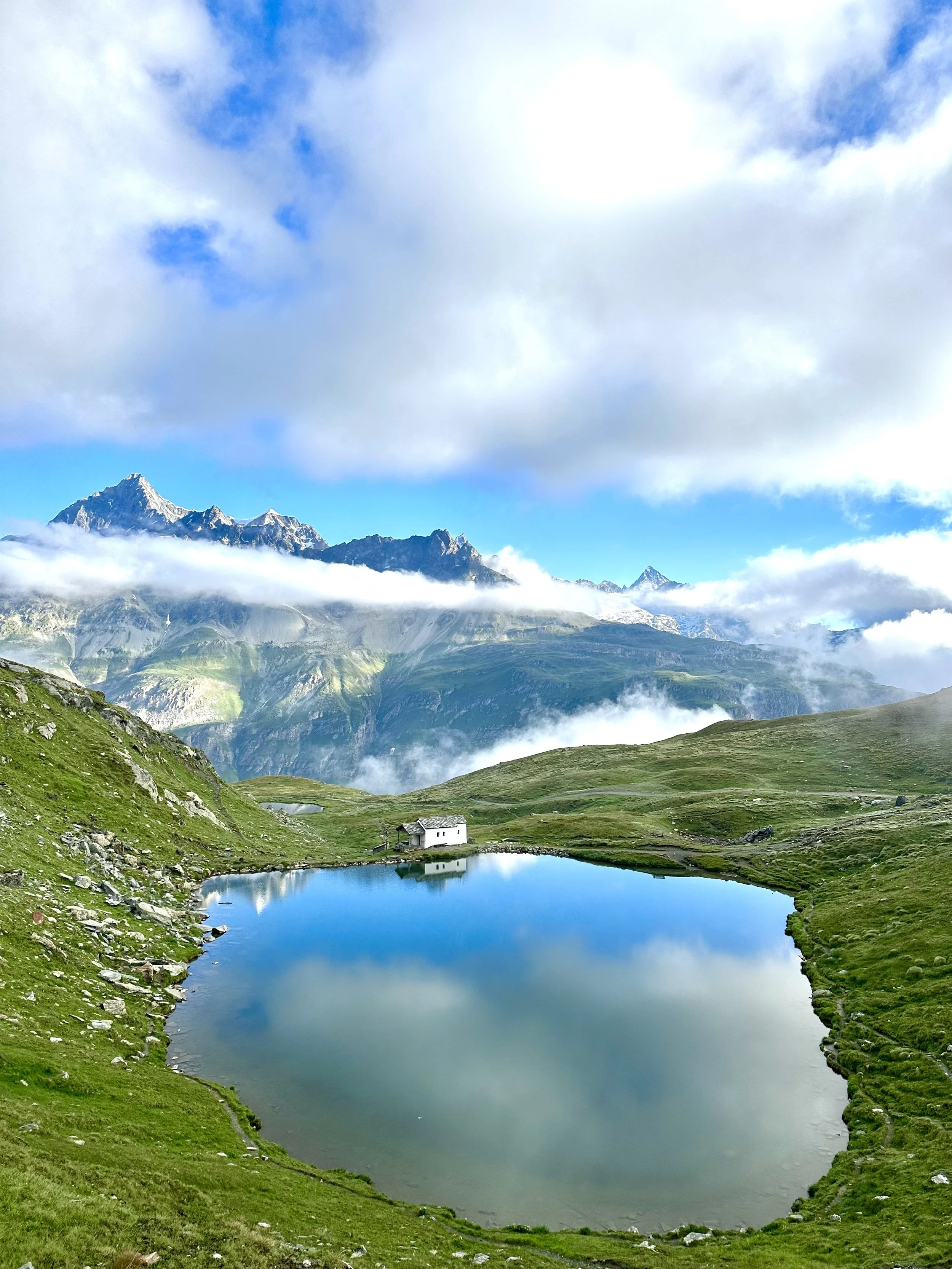
Schwarzsee is one of the most rewarding hiking destinations above Zermatt. Sitting at 2,583 metres beneath the imposing north face of the Matterhorn, it combines spectacular mountain scenery with a peaceful alpine lake, a historic mountain chapel and several excellent hiking options. Whether you arrive on foot or by cable car, it’s a place that invites you to slow down and simply enjoy the surroundings.
There are several ways to reach Schwarzsee from Zermatt, each offering a different experience.
The most direct route climbs steadily beneath the Matterhorn Express cable car. Although fairly steep, the trail is straightforward and well maintained, making it the quickest option for hikers wanting to reach Schwarzsee under their own power.
If you’re looking for a bigger challenge, take the eastern route via Furi. This trail follows what becomes one of the black ski pistes during winter before climbing steadily towards Schwarzsee. It is longer and steeper, making it an excellent choice if you’re looking for a more demanding workout.
Our favourite approach is from the west side via Stafelalp. This beautiful trail passes beneath the towering north face of the Matterhorn through colourful alpine meadows filled with wildflowers during July and August. Marmots are frequently seen along the route. The scenery on this approach is among the finest anywhere around Zermatt.
At Schwarzsee itself, take time to walk around the small dark lake and visit the Maria zum Schnee chapel, one of the highest pilgrimage chapels in the Alps. The Schwarzsee restaurant is an excellent place to enjoy lunch while surrounded by magnificent views of the Matterhorn and the surrounding peaks.
For stronger hikers, Schwarzsee is also the gateway to some of Zermatt’s finest alpine walks. From here you can continue to the Hörnli Hut at the foot of the Matterhorn, or head towards Trockener Steg to join the spectacular Glacier Trail, both of which are described later in this guide.
Insider tip: Unless you’re exhausted, don’t take the cable car back to Zermatt. Walking down is one of the most beautiful descents in the valley. Throughout much of the hike you’ll be facing directly towards Zermatt with the Matterhorn towering behind you, offering magnificent views almost the entire way back to the village.
8. Schwarzsee – Hiking Beneath the Matterhorn
9. Edelweiss High Trail (Höhenweg)– Zermatt’s Most Spectacular Full-Day Hike
Difficulty: ★★★★☆ Challenging
Time: 6–10 hours
Season: Summer (best from July to October)
If we could recommend just one full-day hike in Zermatt, this would be it. The Edelweiss High Trail combines everything that makes hiking in the Alps so special: breath-taking scenery, crystal-clear mountain streams, colourful alpine meadows, dramatic glaciers and some of the most spectacular views of the Matterhorn you’ll find anywhere. Unlike many of Zermatt’s famous hikes, there are no cable cars here. Every metre is earned on foot, making the experience feel all the more rewarding.
The trail begins in Zermatt and climbs steadily through forests and alpine terrain via Edelweiss and Trift huts before reaching the breathtaking Höhbalmen Plateau at around 2,650 metres. Surrounded by glaciers and many of Switzerland’s highest peaks, this wide alpine plateau feels wild, remote and untouched. Even during the height of summer, you’ll often find yourself completely alone.
From Höhbalmen, you have two options. If you’re feeling tired, you can descend directly back to Zermatt. We strongly recommend continuing, however, along the magnificent high traverse towards the valley between the Matterhorn and Dent Blanche. The trail gradually descends through an extraordinary alpine landscape before reaching a beautiful waterfall beneath the north face of the Matterhorn. From there, the route continues through the traditional Zmutt Valley before returning to Zermatt, completing one of the finest circular hikes in the region.
This is a demanding mountain hike rather than a technical one. It requires good fitness, stamina and confidence on mountain trails, but there are no climbing sections or exposed scrambling. If you’re an experienced hiker looking to escape the crowds and experience the wilder side of Zermatt, it doesn’t get much better than this.
Insider tip: Visit in late September or early October if the weather allows. At this time of year, the alpine meadows around Höhbalmen turn brilliant shades of orange, red and gold, creating one of the most spectacular landscapes in the valley. Combined with the complete silence and the absence of crowds, it’s one of the most unforgettable hiking experiences Zermatt has to offer.
Difficulty: ★★★★☆ Challenging
Time: Around 8–10 hours
Season: Summer (best from July to September)
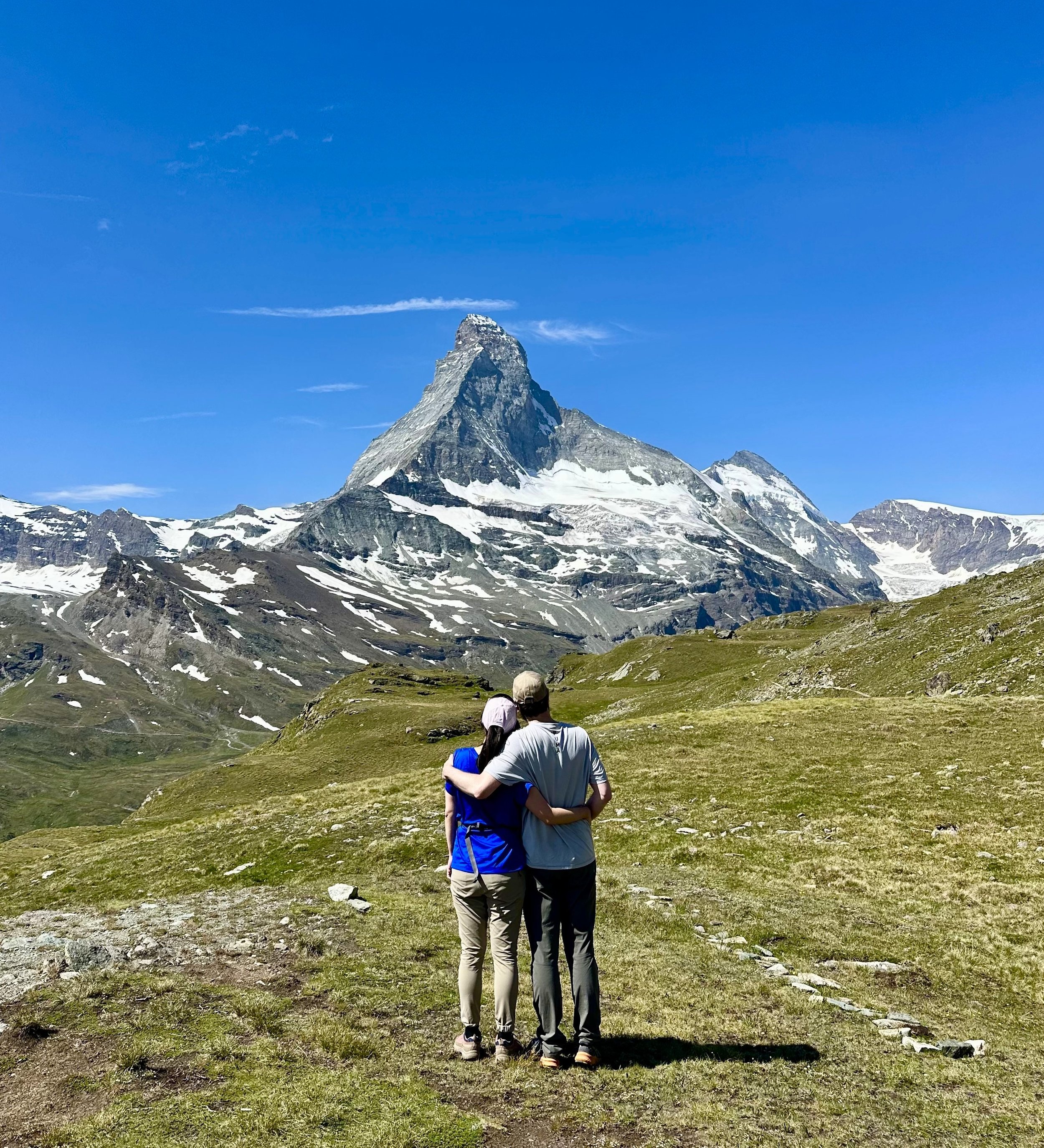
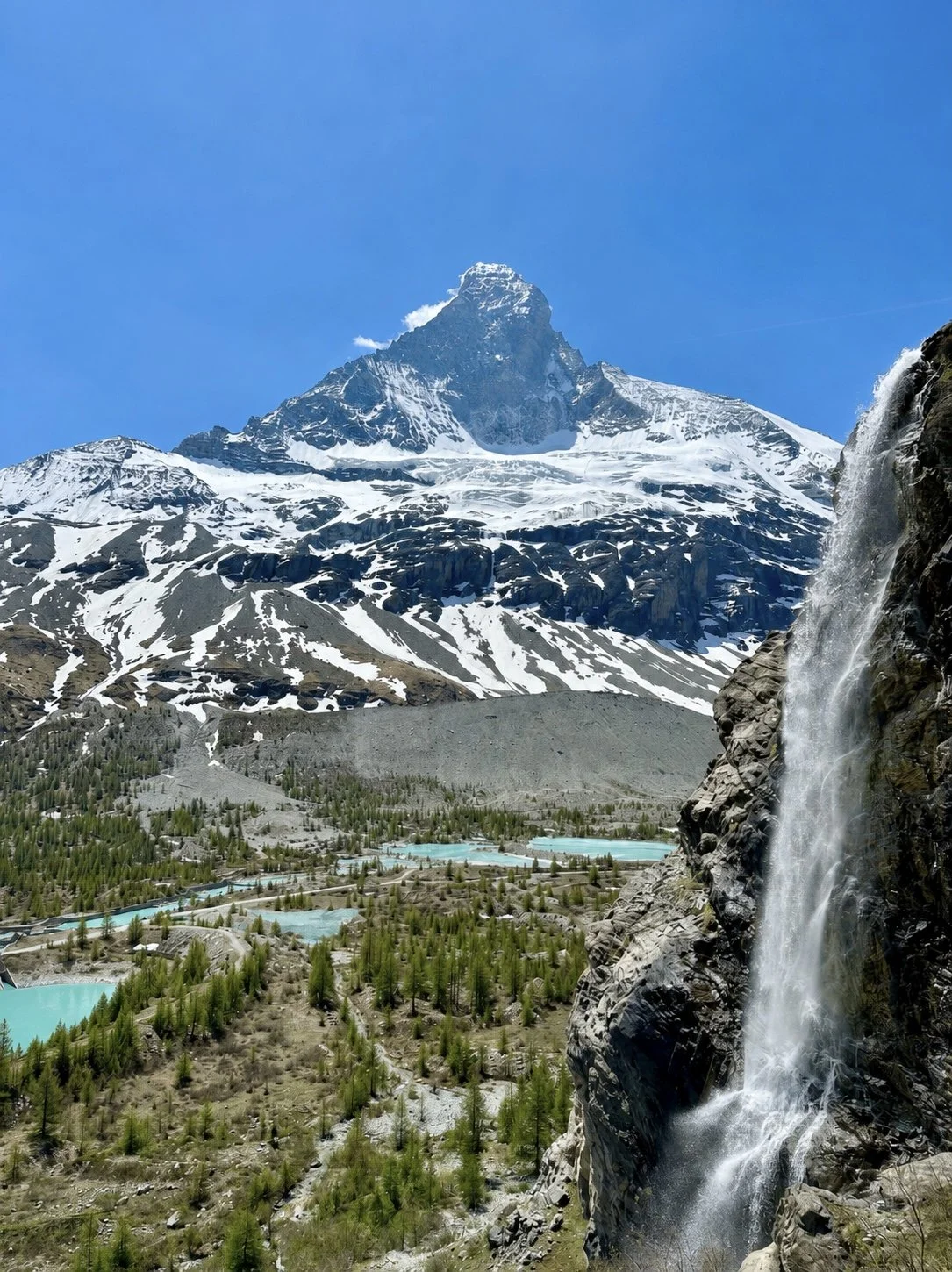
If you’re looking for a true mountain adventure without using a single cable car, this is one of the finest hikes in Zermatt. Starting directly from the village, the trail leads through the peaceful hamlet of Zmutt before climbing ever deeper into one of the wildest corners of the valley. Every step brings you closer to the immense north face of the Matterhorn, making this one of the most rewarding hikes for experienced mountain walkers. The official ascent from Zermatt to Schönbiel Hut takes around 4½ hours, making the full return hike approximately 8–10 hours.
Beyond Zmutt, the trail passes the beautiful Arbenbach Waterfall, one of the most scenic viewpoints beneath the Matterhorn’s north face. As you continue, the landscape becomes increasingly wild. The route follows the edge of the Zmutt Glacier, crossing glacial moraines, alpine streams and rocky terrain shaped by centuries of ice. Towering above the valley is the dramatic north face of the Matterhorn, while across the valley the elegant pyramid of Obergabelhorn comes into view — a magnificent 4,000-metre peak that is rarely seen from the centre of Zermatt.
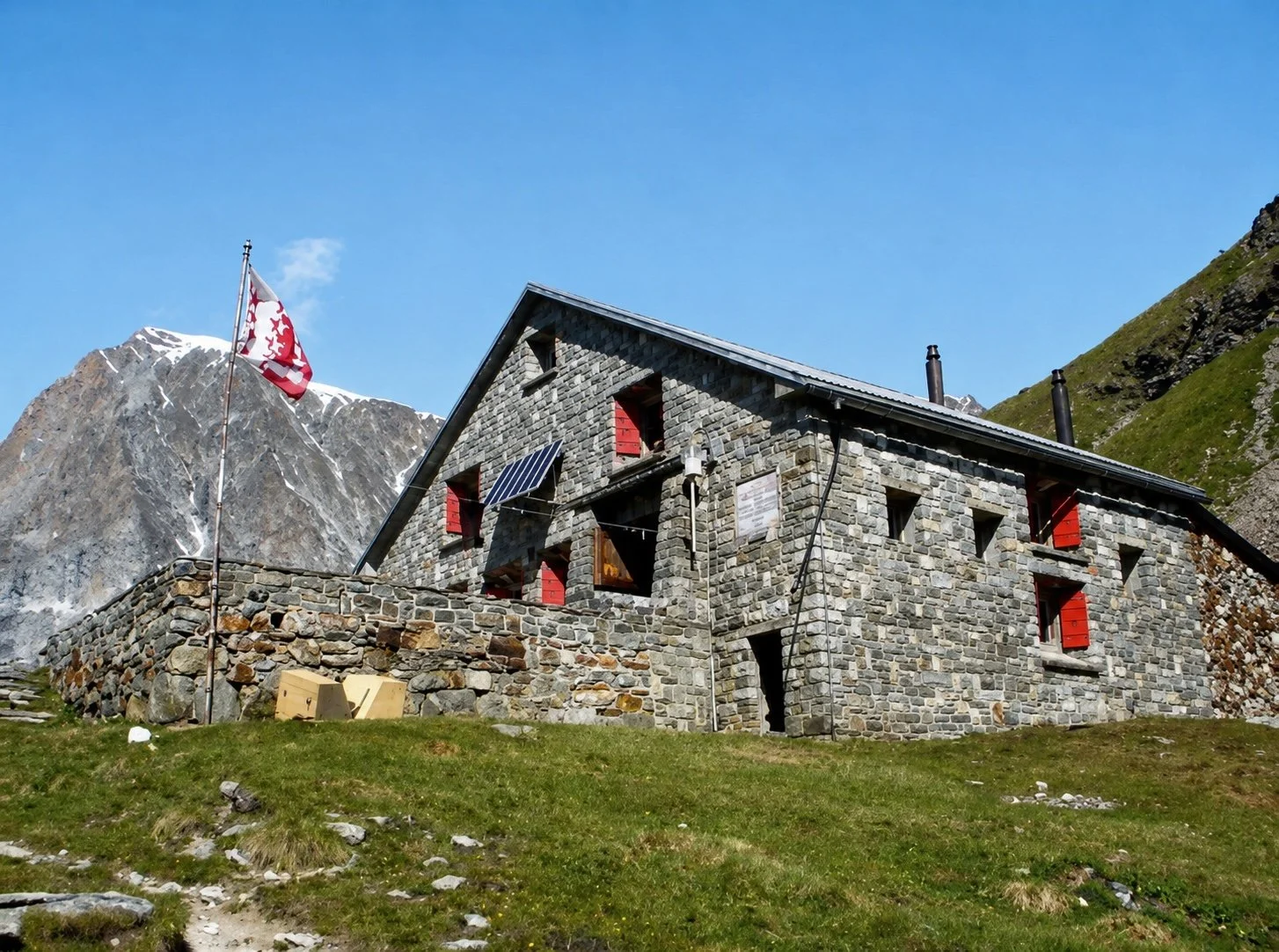
Perched at 2,694 metres, Schönbiel Hut enjoys one of the most spectacular settings of any mountain hut in the Alps. It is the traditional base for mountaineers climbing Dent Blanche, one of Switzerland’s great 4,000-metre summits, but it also makes a wonderful destination for hikers. Reward yourself with coffee and a slice of homemade cake while enjoying unforgettable views of the Matterhorn.
This is also one of the best places around Zermatt to spot Alpine ibex. Early in the morning or late in the afternoon, they are often seen grazing on the rocky slopes above the trail. If you move quietly and give them plenty of space, you may be surprised by how close they allow you to come. Encounters like these are among the most magical experiences the mountains can offer.
Insider tip: Stay overnight at Schönbiel Hut instead of rushing back to Zermatt. As evening falls and most day hikers have gone, the north face of the Matterhorn glows in the last light of the day, and the silence of the valley becomes something truly unforgettable. Waking up here the following morning is an experience you’ll remember long after your visit to Zermatt.
10. Schönbiel Hut – One of Zermatt’s Finest Mountain Hikes
11. Rothorn Hut – Into the Heart of Zermatt’s High Mountains
Difficulty: ★★★★☆ Challenging
Time: Around 8–10 hours
Season: Summer (best from July to September)
The hike to Rothorn Hut is one of Zermatt’s classic high-mountain adventures. Unlike many of the valley’s famous viewpoints, there are no cable cars involved. Every step is earned on foot as you gradually leave the forests behind and enter an increasingly wild alpine landscape. The ascent from Zermatt takes around 4 hours 40 minutes, making the full return hike approximately 8–10 hours.
The trail begins on the Edelweissweg before passing both Edelweiss Hut and Trift Hut. Beyond Trift, the route enters the beautiful Trift Valley, where glaciers, waterfalls and rugged peaks begin to dominate the scenery. As you continue climbing, the lush alpine meadows gradually disappear, giving way to a dramatic landscape of moraine, rock and ancient glacial terrain. On your left, the impressive Trift Glacier stretches high into the mountains, while the final approach follows a spectacular path across its rocky lateral moraine towards the hut itself.
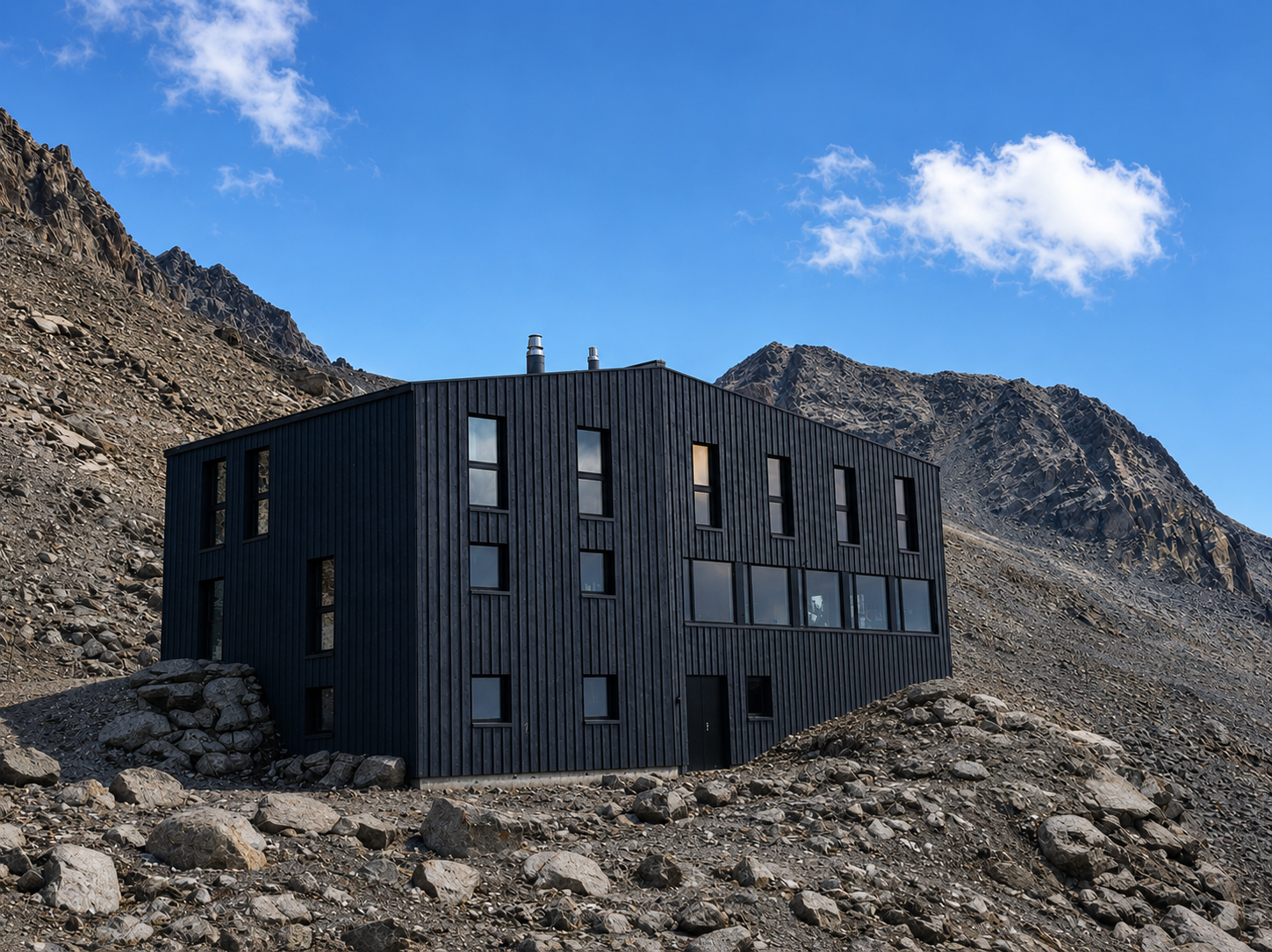
Perched at 3,198 metres, Rothorn Hut sits in an extraordinary location between the elegant pyramids of Zinalrothorn and Obergabelhorn. From the terrace, you’ll enjoy magnificent views across the Monte Rosa massif, the Mischabel range, and many of the highest peaks in the Pennine Alps. It’s no surprise that the hut serves as the traditional starting point for mountaineers attempting Zinalrothorn, and Obergabelhorn, two iconic 4000-m peaks. After the long climb, homemade soup or a well-earned lunch tastes especially good while taking in the remarkable panorama.
Although demanding, the route is technically straightforward for experienced hikers. Good fitness, sure-footedness and mountain experience are essential, particularly on the higher moraine sections where the trail becomes rough and rocky. Keep an eye on the surrounding cliffs and skies — chamois, golden eagles and marmots are all regularly seen in this remarkable wilderness.
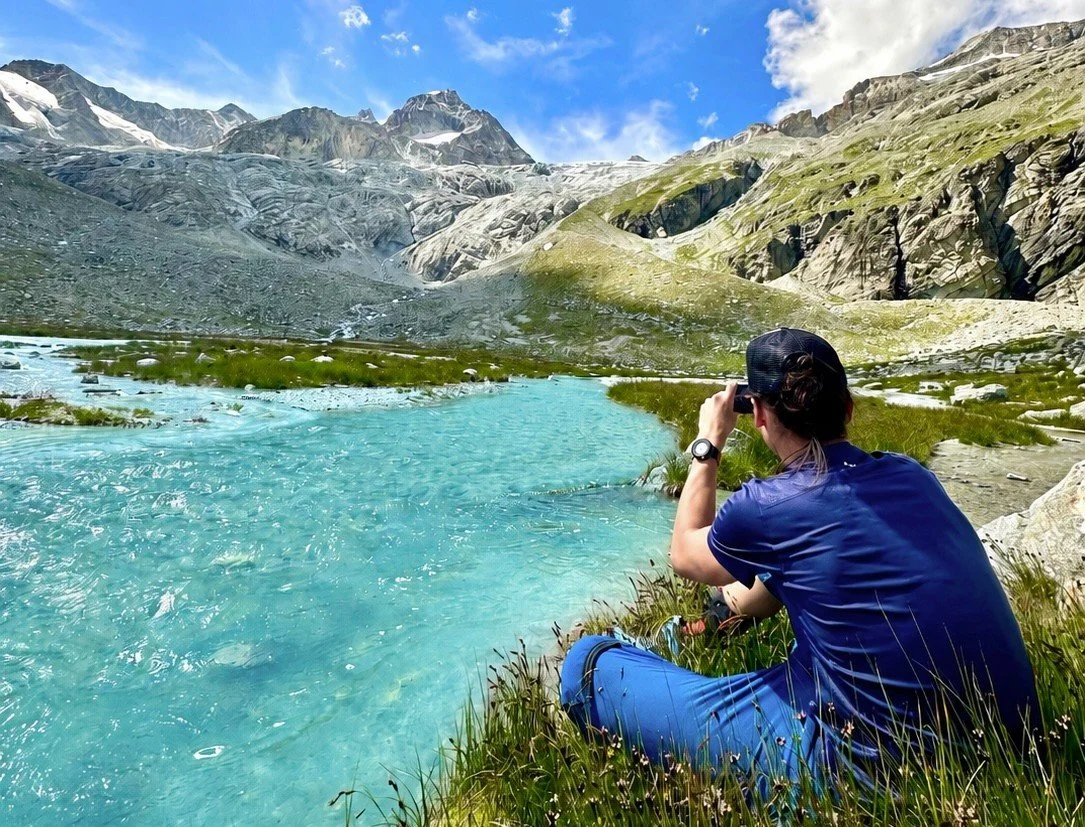
Insider tip: On your way back, stop beside the gentle glacial streams below the final moraine, just before descending towards Trift. Here, crystal-clear meltwater flows through soft alpine meadows, creating one of the most peaceful places in the valley. It’s the perfect spot to take off your boots, sit beside the water and simply forget about the world for a while.
12. Hörnli Hut – The Closest You Can Get to the Matterhorn Without Climbing It
Difficulty: ★★★★☆ Challenging
Time: 4–10 hours
Season: Summer (best from July to September)
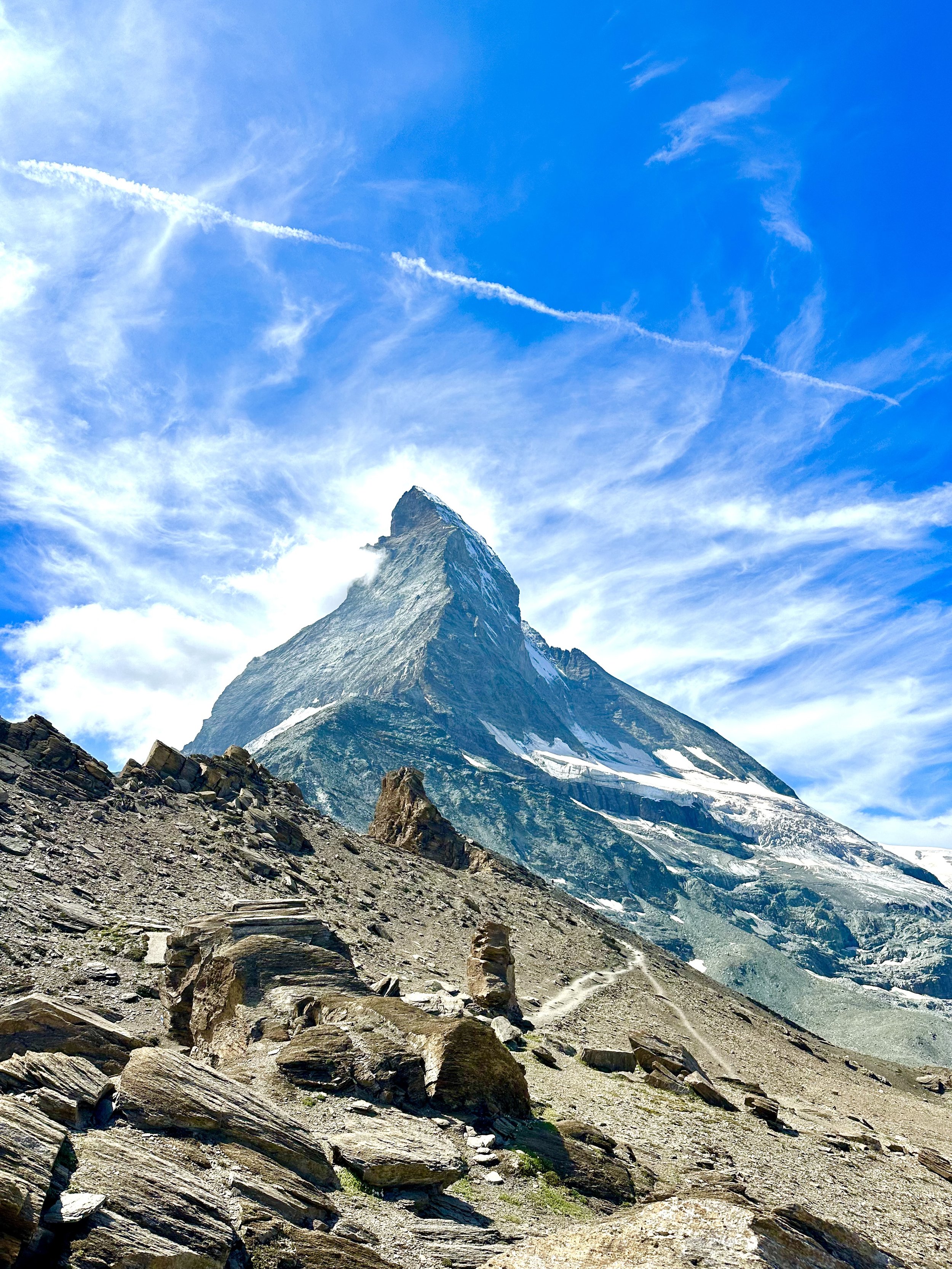
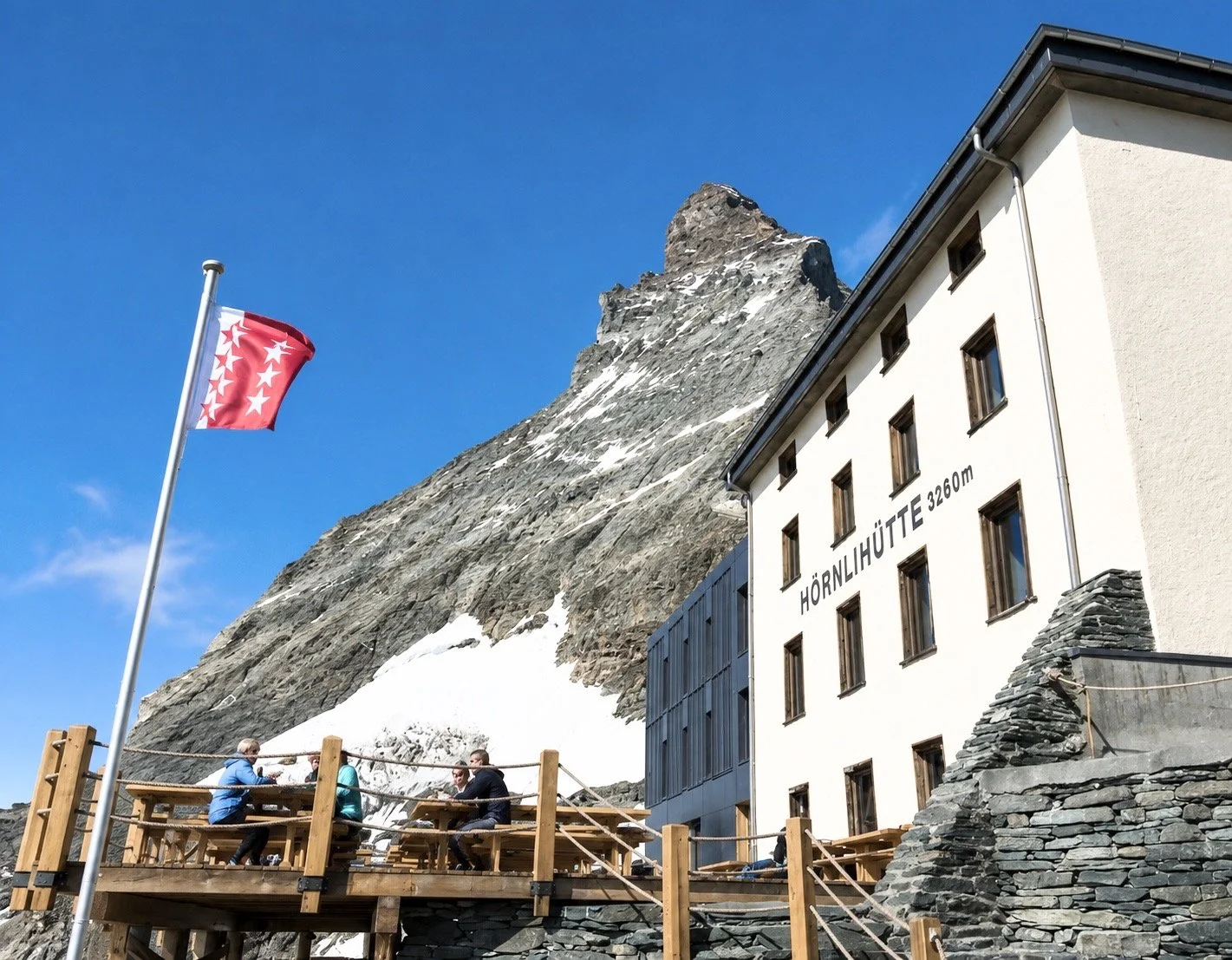
If you’ve ever dreamed of standing beneath the Matterhorn, this is the hike to do. The Hörnli Hut sits at 3,260 metres directly below the famous Hörnli Ridge — the normal route used by mountaineers attempting the summit. Nowhere else can hikers experience the mountain from such an intimate perspective without technical climbing.
There are two ways to reach the hut. The most popular option is to take the cable car to Schwarzsee, from where it takes around 2 to 2½ hours to reach the hut on a steep alpine trail. If you’re looking for a bigger challenge and go in the footsteps of the first brave men who climbed Matterhorn, you can start directly from Zermatt, creating a rewarding full-day hike of around 8–10 hours return.
Although the route is well marked, this is not an ordinary mountain walk. Several sections are exposed, with steep drop-offs beside the trail, and a good head for heights, sure-footedness and proper mountain footwear are essential. One careless step could have serious consequences, so this hike is recommended only for experienced hikers who are comfortable in high-alpine terrain.
As you climb higher, the Matterhorn grows ever larger until it completely dominates the landscape. Along the way there are plenty of places to stop, catch your breath and simply admire one of the world’s most famous mountains. The Hörnli Hut itself is warm and welcoming, serving homemade cakes, soups and traditional Swiss meals. Sitting on the terrace while watching climbers prepare for, or return from, their ascent of the Matterhorn is an unforgettable experience. Every summer, mountaineers from around the world gather here before setting off long before dawn towards the summit.
Insider tip: Before heading back, walk a few minutes beyond the hut towards the start of the Hörnli Ridge. Here, you’ll reach the very foot of the Matterhorn itself. Stretch out your hand and touch the mountain’s ancient rock. It’s a surprisingly emotional moment, and one that many visitors remember long after leaving Zermatt.
13. Oberrothorn – One of the Highest Hiking Summits in Europe
Difficulty: ★★★★☆ Challenging
Time: 3–8 hours
Season: Summer (best from July to September)
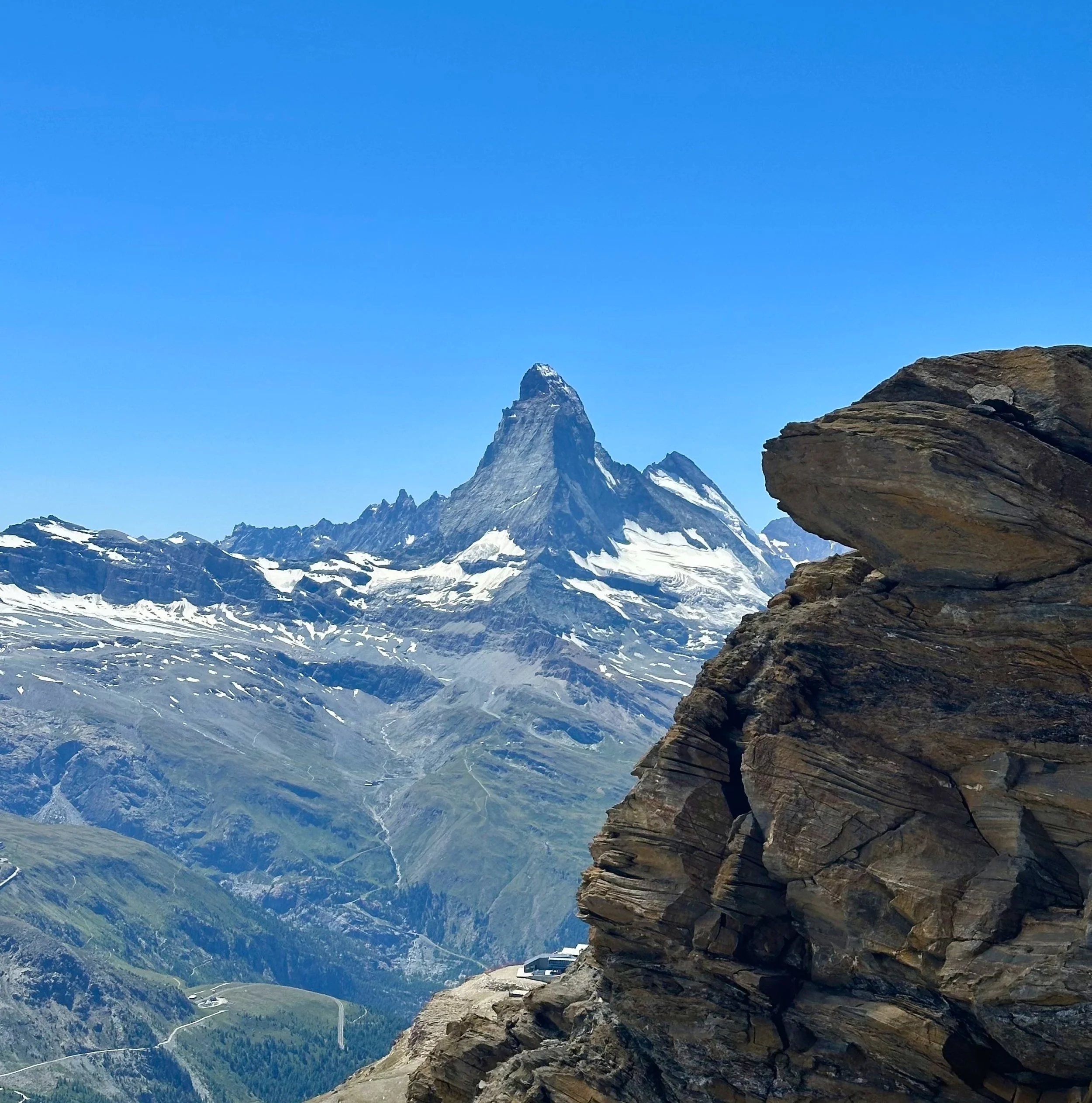
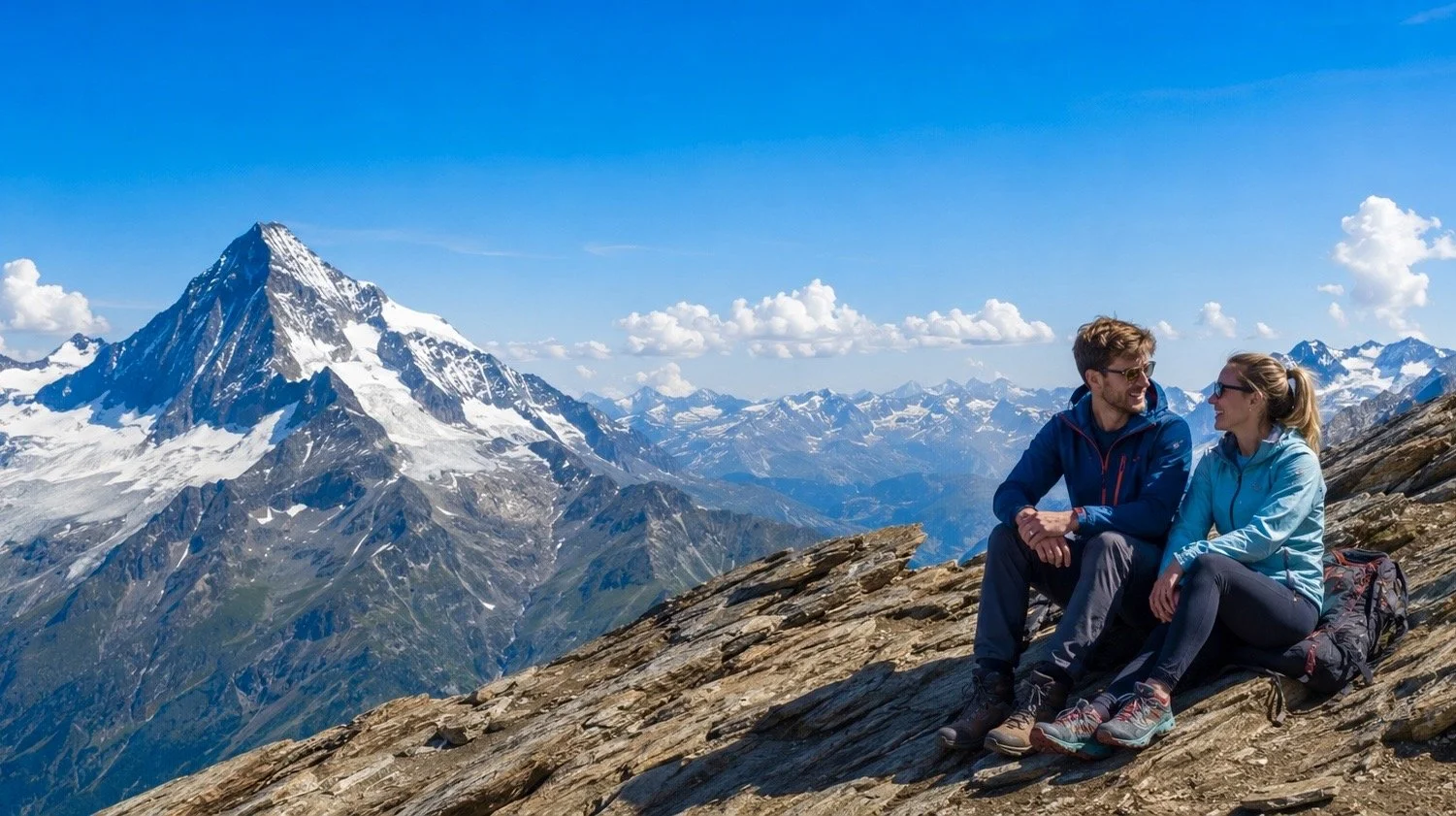
Standing at 3,415 metres, Oberrothorn is one of the highest summits in Europe that can be reached on foot without any climbing equipment. For hikers who enjoy collecting 3,000-metre peaks, this is undoubtedly one of the finest and most rewarding summits in Zermatt. From the top, you’ll be rewarded with an extraordinary 360-degree panorama stretching across the Pennine Alps, with no fewer than 38 peaks above 4,000 metres visible on a clear day.
There are two ways to reach the summit. The shorter option is to take the cable car to Rothorn (3,103 m) and hike the final section to Oberrothorn, which takes around 1½ hours. If you’re looking for a more memorable day in the mountains, start directly from Zermatt and hike via Sunnegga and Blauherd before continuing towards Rothorn and finally Oberrothorn. This creates a full-day adventure of around 7–8 hours. If you ask us, this is by far the more rewarding option.
The final ascent from Rothorn is the most demanding part of the hike. Although the path is well maintained and clearly marked, it climbs steeply over loose rock and scree. A few exposed sections are equipped with fixed ropes to provide extra security, and while no technical climbing is required, sure-footedness and a good head for heights are important. The very last metres involve crossing a rocky slab where careful foot placement is essential.
Unlike many famous Alpine summits, there is no mountain hut or busy viewing platform waiting for you at the top. Instead, you’ll find a surprisingly small, peaceful summit where only a handful of hikers can sit at once. Surrounded by some of the highest mountains in Switzerland, it’s the perfect place to enjoy lunch, absorb the silence and take in one of the most spectacular panoramic views anywhere in the Alps.
Insider tip: Instead of returning the same way, descend towards Stellisee, the first lake on the famous Five Lakes Trail. From there, continue through Grindjisee, Grünsee, Moosjisee and finally Leisee, combining one of Zermatt’s finest summit hikes with its most beautiful lake walk in a single unforgettable day.
14. Platthorn – A Quiet 3,000-Metre Summit Above Zermatt
Difficulty: ★★★★☆ Challenging
Time: 7–9 hours
Season: Summer (best from July to September)
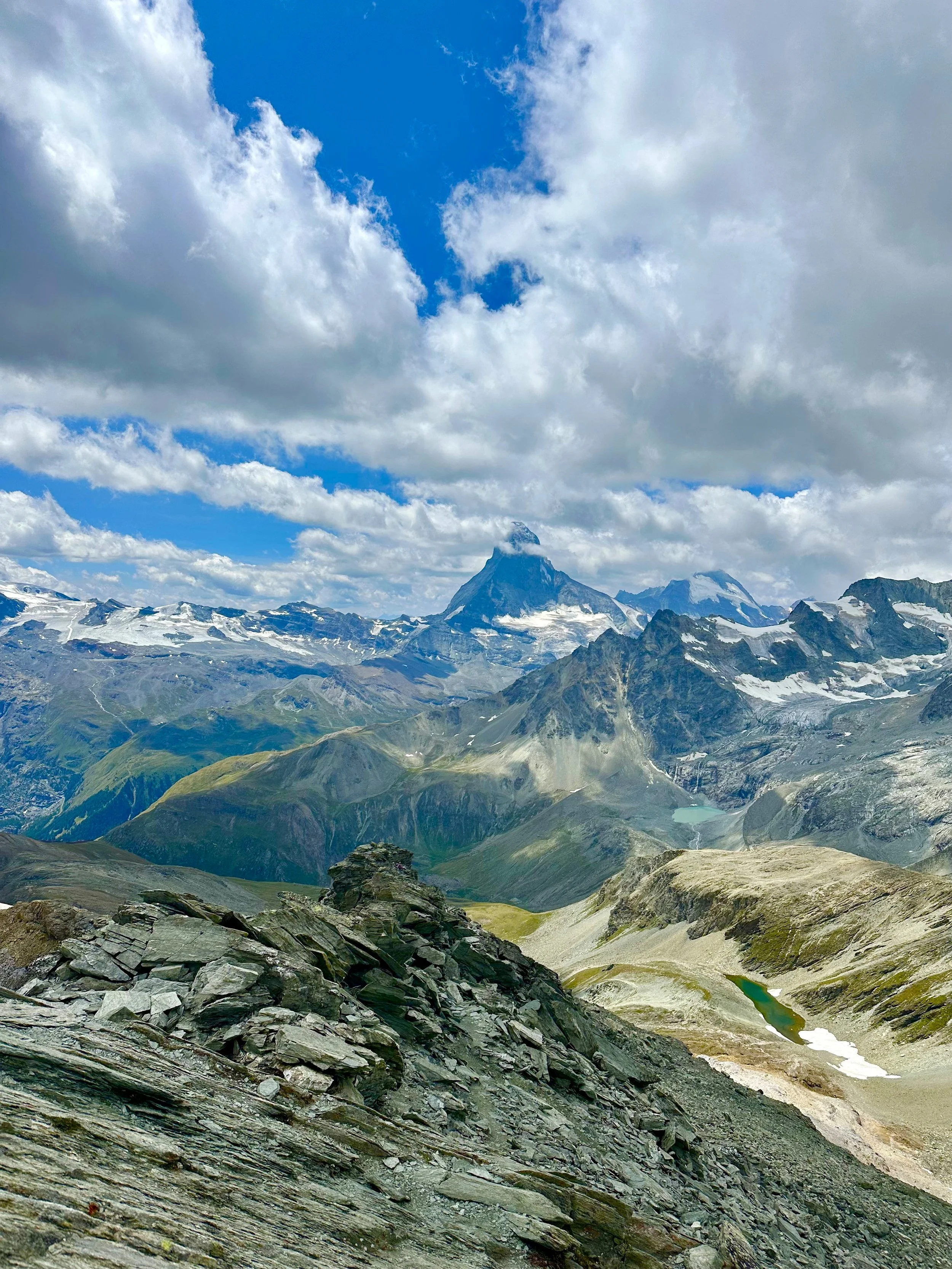
At 3,345 metres, Platthorn is another rewarding 3,000-metre summit that experienced hikers can reach if careful. Often overlooked in favour of its slightly higher neighbour, Mettelhorn, Platthorn offers a quieter summit and some of the finest panoramic views in the Zermatt valley. From here, the Matterhorn appears smaller than from many other hikes, yet it still dominates the skyline, surrounded by countless snow-covered peaks.
There are no cable cars for this hike. Starting in Zermatt, the trail climbs steadily via Edelweiss and Trift before entering the beautiful Trift Valley. Higher up, the landscape changes dramatically as grassy slopes give way to glacial moraine, boulders and rugged alpine terrain. Follow the signs towards Platthorn, enjoying increasingly spectacular views as you climb deeper into one of Zermatt’s wildest mountain landscapes.
The final ascent to the summit is considerably more demanding than the lower part of the hike. Loose rock, steep terrain and exposed sections require concentration and careful footwork. The trail passes close to the glacier, and a mistake here could have serious consequences. This is not a technically difficult climb, but it should only be attempted by experienced hikers who are comfortable in steep, high-alpine terrain. If you are unsure about your experience or would simply like to enjoy the day without worrying about navigation, joining a qualified hiking guide is always the safest and most enjoyable option.
The summit itself is wonderfully understated. There is no mountain hut, no restaurant and no viewing platform — just a small rocky summit large enough for only a few people to sit and enjoy the silence. With uninterrupted views of the Matterhorn, Obergabelhorn, Weisshorn and many of the surrounding 4,000-metre peaks, it is one of the most peaceful viewpoints around Zermatt.
Insider tip: Instead of returning via the same trail, descend into the Trift Valley and follow the signs towards Wisshorn before dropping back to Zermatt. This quieter variation allows you to experience an entirely different side of the valley and makes the descent almost as memorable as the ascent itself.
15. Mettelhorn – One of Zermatt’s Greatest Hiking Summits
Difficulty: ★★★★☆ Challenging
Time: 7–10 hours
Season: Summer (best from July to September)
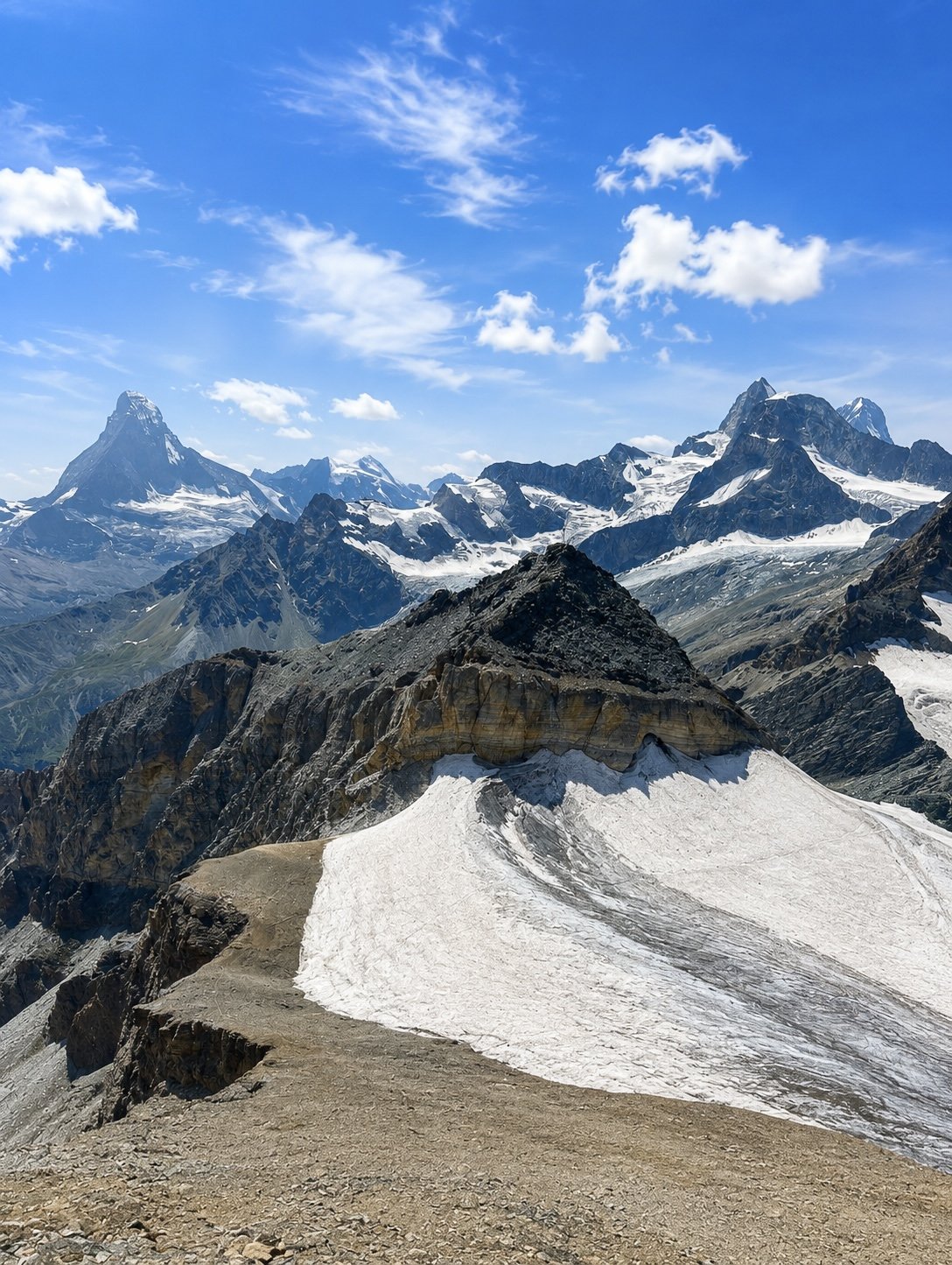
Standing at 3,406 metres, Mettelhorn is widely regarded as one of the finest hiking summits in the Alps. Although it requires no technical climbing, it offers a true high-mountain experience, with spectacular panoramic views and an unforgettable summit that feels remarkably wild considering its proximity to Zermatt. The route from Zermatt takes around 7 hours one way, with approximately 3 hours for the descent.
The route shares its approach with Platthorn. From Zermatt, the trail climbs via Edelweiss, Trift, and into the beautiful Trift Valley, where glaciers, waterfalls and towering peaks gradually replace forests and alpine meadows. Beyond Trift, the landscape becomes increasingly rugged as the trail climbs towards Furgji, before splitting towards either Platthorn or Mettelhorn.
Unlike Platthorn, reaching Mettelhorn requires crossing a small section of the retreating glacier before the final ascent. Depending on conditions, this glacier crossing may require microspikes or crampons, and conditions should always be checked before setting out. The final climb is steep and exposed, rewarding hikers with one of the most breathtaking 360-degree panoramas anywhere around Zermatt. From the summit, the Matterhorn, Weisshorn, Zinalrothorn, Obergabelhorn, Monte Rosa and countless other Alpine giants seem almost within touching distance.
Although the route is well marked, it is intended for experienced hikers who are comfortable in steep, high-alpine terrain. If you’re unsure about your experience or would simply like to enjoy the day without worrying about navigation or mountain conditions, joining a qualified hiking guide is always the safest and most enjoyable option. Before attempting the summit, it is also worth checking current conditions at Trift Mountain Inn, as glacier conditions can change throughout the season.
Insider tip: If you still have energy after reaching Mettelhorn, continue on to Plathorn. Completing both 3,000-metre summits in a single day is one of Zermatt’s finest hiking achievements—and something you’ll be proud to remember long after your visit.
16. Monte Rosa Hut – One of the Alps’ Greatest High-Mountain Hikes
Difficulty: ★★★★★ Hard
Time: 8–10 hours
Season: Summer (best from July to September)
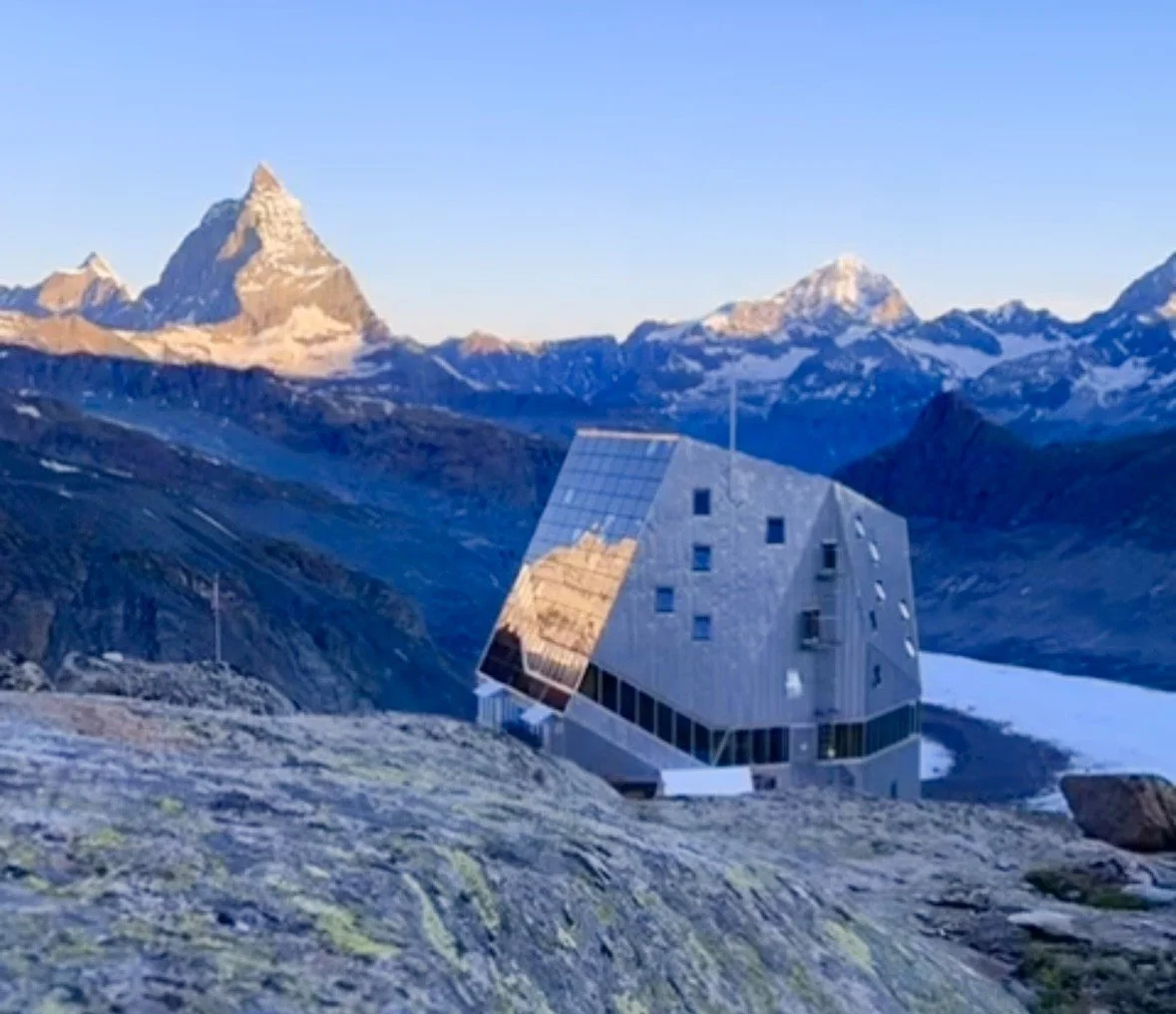
The hike to Monte Rosa Hut is one of the most spectacular and demanding adventures that can be undertaken around Zermatt. Surrounded by the immense Gorner Glacier, Grenz Glacier and the towering peaks of the Monte Rosa massif, the route takes you deep into one of the wildest alpine landscapes in Switzerland. The hut itself, standing at 2,883 metres, is famous for its striking futuristic architecture, often compared to a spaceship perched among the glaciers.
The standard approach begins at Rotenboden, just below Gornergrat, after taking the Gornergrat Railway. From here, allow approximately 4 to 4½ hours to reach the hut, making the return journey around 8–9 hours. Exceptionally strong hikers may choose to start directly from Zermatt, but this makes for a very long and demanding day and is recommended only for those with outstanding fitness and mountain experience.
The trail initially follows the eastern side of the magnificent Gorner Glacier, one of the largest glaciers in the Alps. After about an hour, the route descends steeply towards the glacier on a series of rocky paths equipped with ladders, fixed ropes and metal footholds. These sections require careful footing and should never be underestimated. The route then continues through moraine, polished rock slabs and alpine terrain before reaching the glacier itself.
Unlike many glacier walks in the Alps, the current official summer route still requires crossing the Gorner Glacier. The exact line changes every season as the glacier moves and crevasses open, but hikers are still required to walk on the glacier itself. Crampons are mandatory, and depending on current conditions, a harness, ice axe and even a rope may also be necessary. The route is marked with poles, but this remains genuine glacier terrain.
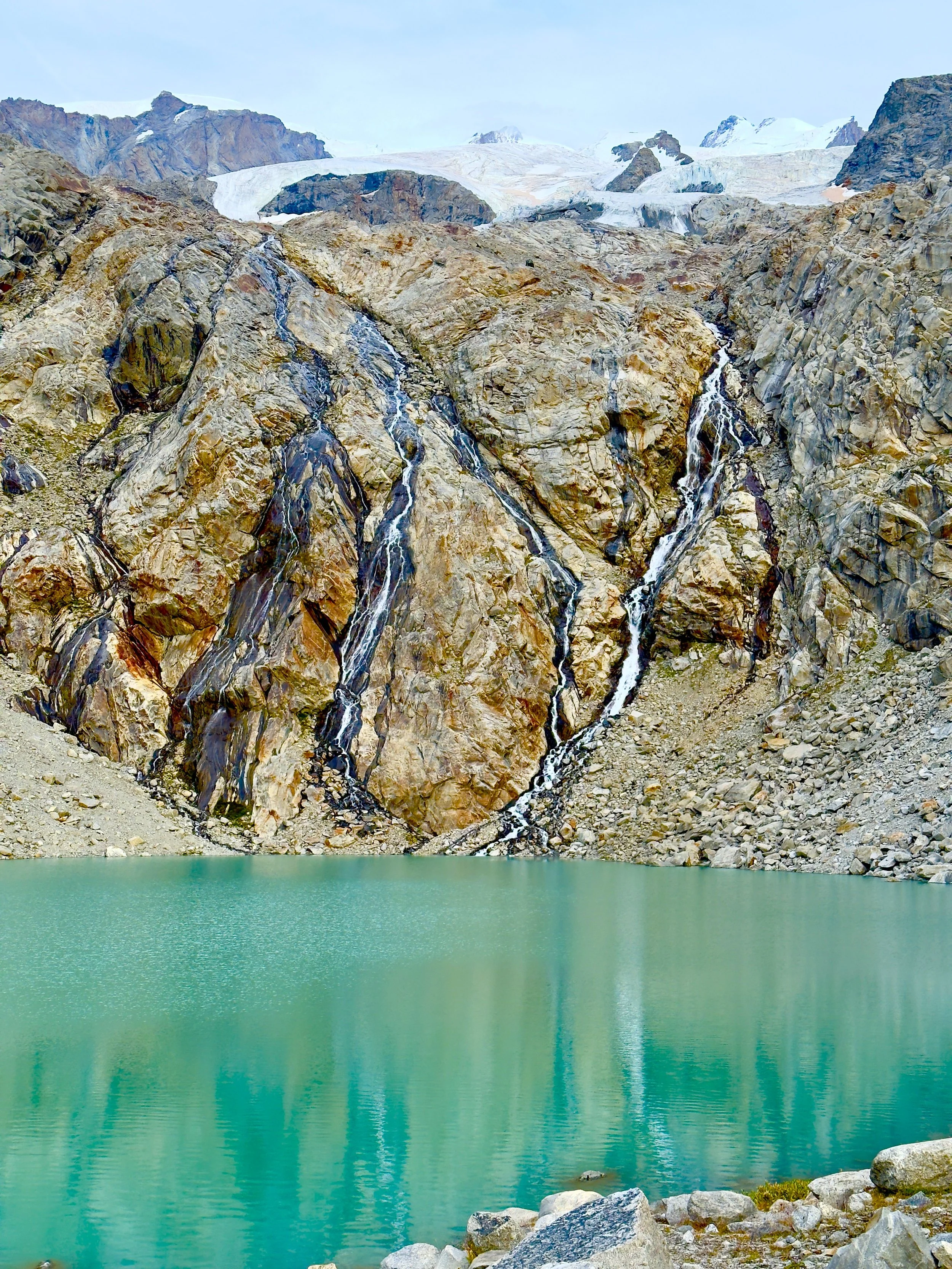
After leaving the glacier, the final climb leads steadily uphill past beautiful turquoise meltwater pools and waterfalls cascading from the surrounding glaciers. Eventually, the remarkable Monte Rosa Hut comes into view, offering breathtaking panoramas of the Monte Rosa massif and its surrounding glaciers. It’s the perfect place to enjoy a well-earned meal or homemade cake while watching climbers prepare for ascents of Dufourspitze, Nordend, Lyskamm and other famous 4,000-metre peaks. Alpine ibex are frequently seen around the hut, often grazing surprisingly close to the building.
Because of the glacier crossing and constantly changing mountain conditions, this is one hike for which we strongly recommend hiring a qualified mountain guide, even for experienced hikers. The route is serious alpine terrain, and local knowledge of current glacier conditions makes the journey both significantly safer and far more enjoyable.
Insider tip: Stay overnight at Monte Rosa Hut rather than rushing back the same day. As the evening light falls across the glaciers and the crowds disappear, you’ll experience one of the quietest and most magical places in the Alps. Waking up here, surrounded by ice, rock and Switzerland’s highest mountains, is an unforgettable experience.